Premises liability notice for NC slip-and-falls


On this page
An insurance adjuster’s favorite line after a fall is simple: the property never knew the hazard was there. That single claim, phrased as notice, is often the entire fight in a North Carolina premises liability case. Whether a grocery store, an apartment complex, or a beach rental gets held responsible for a spill, a broken step, or a torn strip of carpet usually comes down to what the owner knew, or should have known, before you fell.
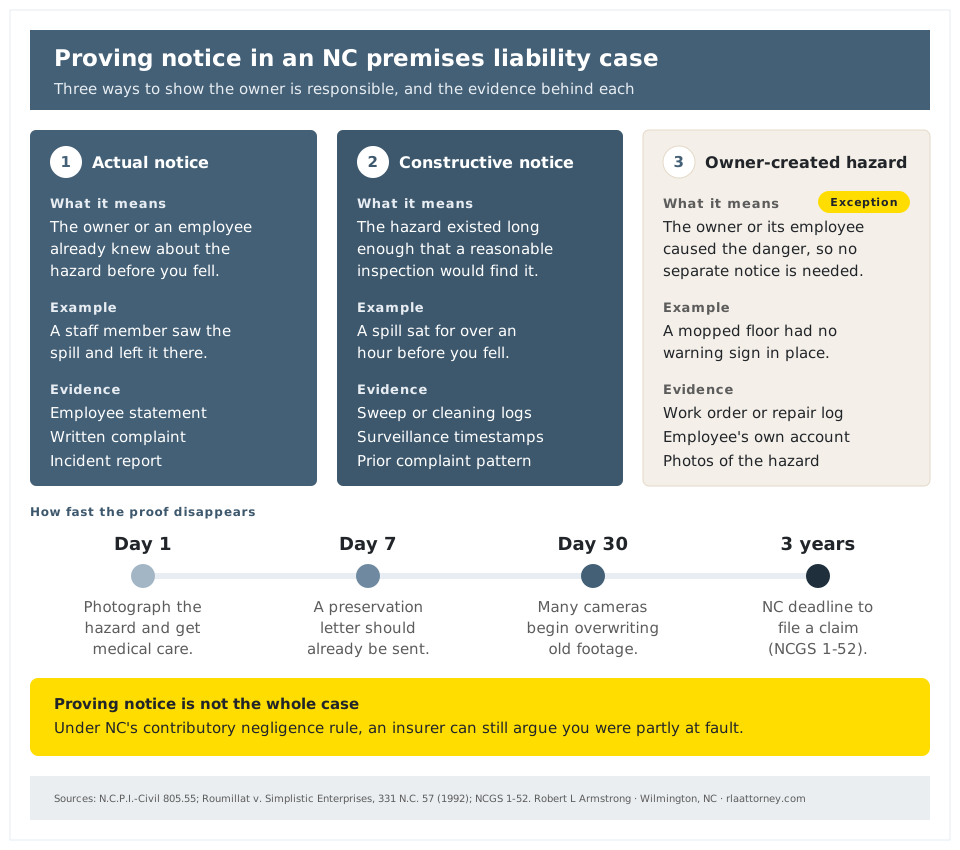
This post walks through how North Carolina courts define actual notice and constructive notice, when an owner needs no notice at all because it or an employee created the hazard, and what kind of evidence proves each one before that evidence disappears. I’m Robert L Armstrong, and I have handled premises liability cases in eastern North Carolina for over 41 years.
What premises liability notice means under North Carolina law
North Carolina dropped its old invitee and licensee categories in 1998. In Nelson v. Freeland, the state Supreme Court held that a property owner owes every lawful visitor a duty of ordinary care to keep the property reasonably safe. That duty is the backbone of every slip-and-fall claim I handle, and it only reaches lawful visitors, meaning anyone with permission to be on the property. A trespasser is owed a narrower duty under a separate statute, which is why a lawful visitor determination often comes first in a disputed case.
Ordinary care does not make a property owner an insurer of every visitor’s safety. Under Roumillat v. Simplistic Enterprises, a 1992 decision from the North Carolina Supreme Court, an injury victim has to prove one of two things: that the owner, or its employee, created the dangerous condition, or that the owner failed to fix or warn about the condition after actual or constructive notice of it. That second half, proving what the owner knew or should have known, is what this post calls the notice requirement.
Proving actual notice when the owner already knew
Actual notice is the more straightforward proof. It means someone connected to the property, an employee, a manager, a maintenance worker, personally knew about the hazard before you were hurt. Evidence of actual notice includes:
- A written or verbal complaint from an earlier customer or tenant
- An employee’s own statement that they saw the spill, the broken step, or the loose railing
- An incident report filed after a near miss
- A work order or repair request describing the same hazard
In Warren v. Rosso and Mastracco, Inc., a 1985 case from the North Carolina Court of Appeals, a grocery store employee admitted he knew about a hazardous substance on the floor before a customer slipped in it, and said cleaning it up was not his job. That admission alone was enough to carry the case past summary judgment. Courts do not require a customer to catch an employee in the act. A manager’s own notes, texts, or radio log can supply the same proof months later.
Hazards the owner created need no notice at all
Notice drops out of the case entirely when the owner or its own employee created the hazard. The North Carolina pattern jury instruction on a landowner’s duty to lawful visitors, published by the UNC School of Government, explains that an owner is responsible for any hidden dangerous condition that the owner’s own conduct, or that of its employees, created. A mopped floor with no warning cone, a torn carpet edge left over from a recent repair, or a display that an employee stacked unsafely all fall into this category. I do not have to prove the store knew about a hazard it built.
Constructive notice and how long the hazard was there
Most premises cases turn on constructive notice instead, because most hazards come from spills, debris, or wear rather than an employee’s own hands. Constructive notice means the hazard existed long enough that a reasonably careful owner, inspecting the property the way it should, would have found it. North Carolina’s courts have applied this test for decades. In Powell v. Deifells, Inc., the state Supreme Court held that a plaintiff must show the condition existed long enough that the defendant knew, or by reasonable care should have known, of it in time to remove the danger or warn about it.
Under this test, the key question is how long the hazard was there, and the evidence of that timeline tends to disappear first. In Hinson v. Cato’s, Inc., a plaintiff lost her case because the record did not show whether the hazard had existed for a week, a day, an hour, or one minute, and the court would not guess. Proving how long a hazard sat there usually comes from:
- Sweep sheets or cleaning logs showing when an aisle or walkway was last checked
- Surveillance video timestamped from before the fall
- Staff schedules showing who was assigned to inspect the area and when
- Physical signs of age in the hazard itself, like footprints and cart tracks through a spill, dried edges, or dirt that has built up around it
A pattern of complaints can shorten the clock
Recurring hazards are often easier to prove than a one-time spill nobody reported. When the same problem keeps coming back, a leaking cooler that puddles every afternoon or a walkway that floods in every hard rain, earlier complaints show the owner knew the condition was likely to return and had reason to watch for it. If you slipped on the same stretch of sidewalk, the same leaking cooler, or the same worn stair tread that other people had already complained about, ask whether anyone reported the problem before you. Store review sites, prior repair requests, and even other tenants can help confirm that pattern.
What insurers argue once notice is proven
Proving notice does not end the fight. North Carolina’s contributory negligence rule bars any recovery if the injured visitor is even slightly at fault, and insurers know it. Once an adjuster cannot deny that the hazard existed long enough to matter, the argument usually shifts to you: you should have seen the wet floor, you were looking at your phone, you walked around a cart instead of using the aisle everyone else used. That fault defense comes up in nearly every slip-and-fall claim I work, and it is a separate fight from notice, not a substitute for it. An owner does not get out of the notice requirement just by arguing you should have been more careful.
What evidence proves notice, and why it disappears fast
Every category of proof above shares one problem: property owners are not required to keep it around forever, and some of it is built to vanish quickly.
- Surveillance video. Many retail and commercial systems overwrite footage automatically, sometimes within days, unless someone tells the business to save it.
- Incident reports. A report filed the day you fell may exist only in a manager’s file or a corporate claims system that a store employee cannot pull up once you have left the building.
- Sweep sheets and maintenance logs. Cleaning and inspection records are often kept for a set retention period and then discarded on a routine schedule that has nothing to do with your case.
- Prior complaints. A verbal complaint leaves no paper trail at all unless someone wrote it down, which is why finding a written work order or a text message to a manager matters so much.
Evidence is not the only clock running. Most North Carolina personal injury claims, including slip-and-fall and other premises cases, must be filed within three years under NCGS 1-52. That deadline has nothing to do with when the surveillance video gets erased, and by the time three years have passed, the proof of notice is usually long gone anyway.
A preservation letter, a written request that tells the property and its insurer to save specific evidence before it is deleted or thrown out, is the tool that stops this clock. I send one early in a case, asking for the video from a defined time window, the incident report, the inspection logs for that day, and any prior complaints about the same area. Waiting even a few weeks can mean the difference between watching the fall on video and arguing about what a witness remembers.
Getting help with a premises liability notice question in Wilmington
Whether a property owner already knew about a hazard, should have caught it during a routine walk-through, or built the danger itself with a careless repair or an unmarked wet floor usually decides a premises case, and the proof lives in logs, video, and reports that get discarded fast. I handle every case personally, from proving notice to documenting fracture injuries and the other harm a fall causes. The consultation is free, and there is no fee unless I win. I work with injury victims and their families across New Hanover, Brunswick, Pender, Onslow, Bladen, and Duplin counties.
If a fall left you hurt and you are not sure what the property knew, Talk to a Wilmington premises liability lawyer before the evidence that would prove it is gone.
Frequently asked questions
What’s the difference between actual and constructive notice in a premises liability case?
Actual notice means someone at the property already knew about the hazard, through a complaint, an employee’s own observation, or an incident report. Constructive notice means nobody admits to knowing, but the hazard existed long enough that a reasonable inspection would have caught it. Both satisfy the same legal requirement; they are just proven with different evidence.
Do I have to prove exactly how long the hazard was there?
You have to prove enough for a jury to conclude the property had time to find and fix it. North Carolina courts have thrown out cases where nobody could say whether a hazard had existed for a week or a minute, so sweep logs, surveillance timestamps, and physical signs of age, like dust on top of a spill or footprints through it, all help establish that timeline.
If an employee caused the spill or left the hazard, do I still need to prove the property knew about it?
No. When the property owner or one of its own employees created the dangerous condition, North Carolina law does not require separate proof of notice. Creating the hazard is treated as the negligence.
Does it help if other people complained about the same problem before I got hurt?
Yes. A documented pattern of prior complaints, prior falls, or repeated repair requests about the same condition can be some of the strongest notice evidence in a case, even stronger than pinpointing the exact minute your hazard appeared.
How do I make sure the store or landlord doesn’t erase the surveillance video?
Once you hire me, I send a preservation letter asking the property and its insurer to save the video, incident reports, and maintenance logs from a specific window of time. The sooner that letter goes out, the less likely the footage is already gone.
Does the insurance company still try to blame me even after I prove notice?
Almost always. North Carolina’s contributory negligence rule lets an insurer avoid paying anything if it can show you were even slightly careless. Proving notice and defending against that argument are two separate jobs, and I handle both.
How much does it cost to find out whether I have a premises liability notice case, and how long do I have to file?
The consultation is free, and there is no fee unless I win. Most North Carolina injury claims must be filed within three years, though the sooner you call, the more notice evidence is still around to find.
Ask the property to save its surveillance video before the system overwrites it.
The footage, reports, and logs that prove a property knew about a hazard are often gone within days unless someone asks the business to save them. Get a free review of what notice evidence might still exist in your case.
Related Articles

Contributory negligence in NC slip and fall claims
NC's 1% contributory negligence rule can bar a Wilmington slip and fall claim over footwear, phone use, or an obvious hazard. Schedule a free consultation.

Hip fracture fall injury in NC and the notice rule
Hip or heel fracture from a store or rental fall in Wilmington? See the 4 facts NC law requires, from owner notice to surgery records. Free consultation.
Who's liable after a broken stairs injury in NC
NC code sets exact handrail and guard heights for rental stairs. See who answers for a broken stairs injury and get a free consultation in Wilmington, NC.