Deck collapse lawsuit in NC for beach rental guests

On this page
A summer week at the beach usually centers on the deck. It is where families eat, watch the ocean, and line up for the group photo. On the raised houses along Wrightsville Beach, Carolina Beach, Topsail Island, and the Brunswick County islands, that deck may sit 10 or 15 feet above the sand on posts and bolts that have spent years in salt air. When it gives way, the fall is rarely minor. Spinal fractures, head injuries, and shattered ankles are common, and several people are often hurt at once.
This post covers what makes coastal decks fail, who may be responsible when one collapses at a vacation rental, how North Carolina law treats the people who were standing on it, and the deadlines that can end a claim before injury victims and their families are ready to think about one. I’m Robert L Armstrong, and I have handled personal injury cases in eastern North Carolina for over 41 years.
Why decks on the NC coast fail
The structural side of a collapse, like ledger boards and joist spans, is covered on my page about deck collapse claims and how I investigate them. Here I want to focus on three conditions I see again and again at coastal rentals, because each one points toward a different responsible party.
Salt air and corroded fasteners
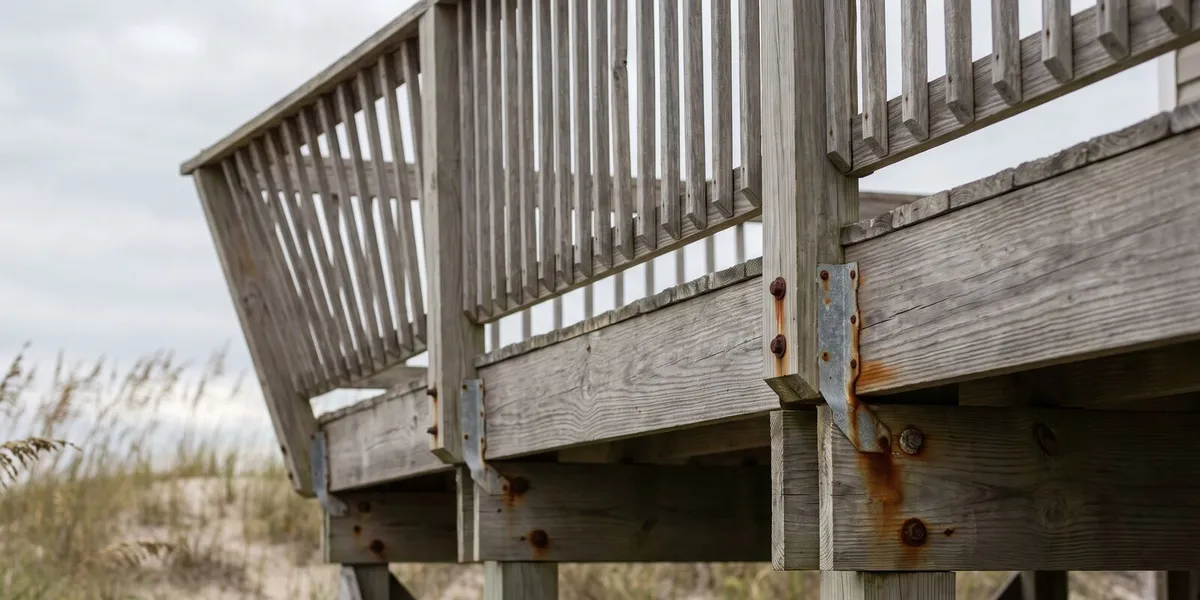
Joist hangers, lag screws, and through-bolts corrode much faster within a few miles of the ocean. Rust that starts as orange streaks on a board can eat through the steel inside a connection, where nobody sees it. The American Wood Council’s DCA 6 deck guide, which is based on the International Residential Code, calls for corrosion-resistant fasteners and connectors throughout the deck. Near salt water, many builders use stainless steel for that reason. Hardware that would last decades in an inland backyard may not last ten years on the oceanfront at Topsail Island.
Crowds and guest limits
Rental listings cap how many people can stay overnight, and insurers like to point at that number after a collapse. The engineering tells a different story. Under the residential code, a deck is designed to carry a live load of 40 pounds per square foot on top of its own weight. A 12-by-16-foot deck built to that standard is designed for 7,680 pounds of people and furniture, which is roughly 40 adults. When a deck fails under a family of 20, the weakness was usually there before the crowd arrived.
Code violations hidden under the boards
Many beach houses were built decades ago, and their decks get rebuilt, extended, and patched between rental seasons. A replacement deck may skip the permit. A handyman may nail a ledger board to the house instead of bolting it. A railing post may be screwed to the rim joist with nothing behind it. None of this shows from the deck surface. It shows up in the permit file, the repair invoices, and the failed pieces themselves, which is why those pieces need to be preserved.
Who can be held liable when a rental deck gives way
A deck collapse at a vacation rental rarely has just one responsible party. The owner, the manager, the builder, and the insurers behind each of them all have a place in the picture, and the filing deadlines differ depending on who you are pursuing.
The owner or vacation-rental host
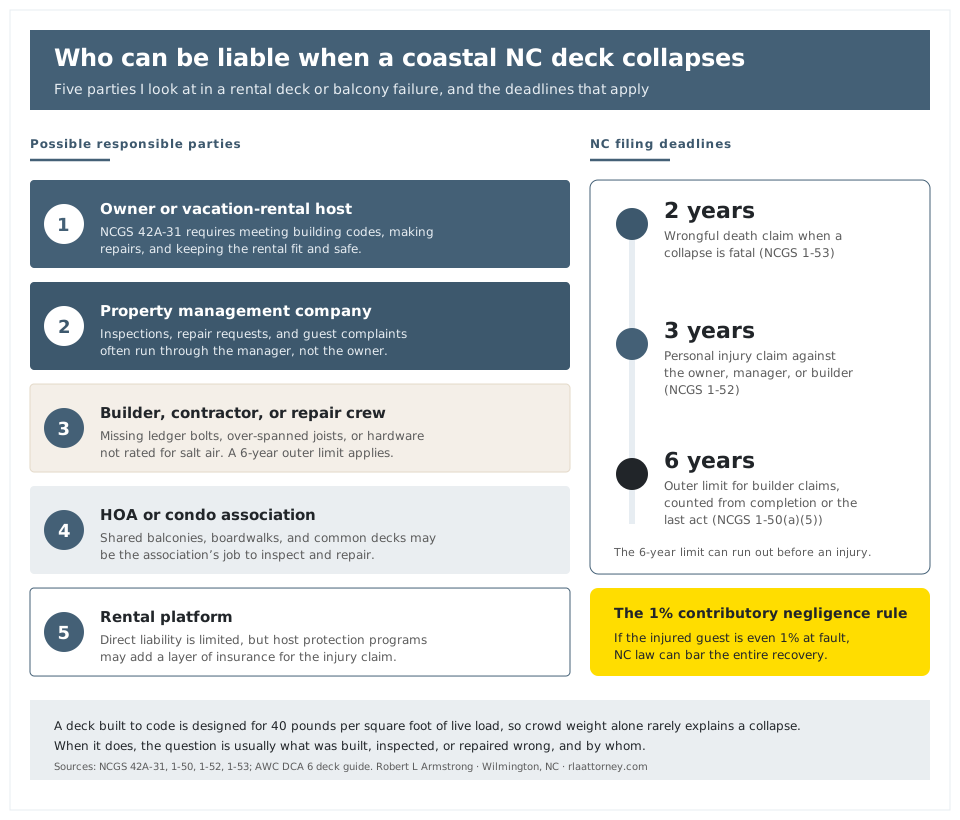
North Carolina’s Vacation Rental Act covers most beach rentals of less than 90 days. Under NCGS 42A-31, the landlord of a vacation rental must comply with applicable building and housing codes, make the repairs needed to keep the property fit and habitable, and keep common areas in safe condition. A deck and its railings fall inside those duties. An owner who received complaints about a wobbly railing, or saw rust bleeding through the boards and kept renting the house, has a hard time explaining that choice to a jury.
The property management company
Many coastal owners live out of state and hand the house to a local management company. The manager may take guest complaints, schedule repairs, and walk the property between stays. Depending on the management agreement, a manager who ignored a reported problem can share responsibility. The same questions about managers and repair logs come up in other vacation rental injuries, like falls on broken stairs.
The builder, contractor, or repair crew
When a deck fails because of how it was built or repaired, the contractor who did the work can be responsible. That includes the crew that replaced rotten joists last spring without adding the missing bolts. Claims against builders face a separate deadline called the statute of repose, which I explain below.
The HOA and the rental platform
In condo buildings and planned communities, balconies and shared boardwalks may belong to the association, which then carries the duty to inspect and repair them. Booking platforms are usually not treated as the owner, but their host protection programs can add a layer of insurance. My post on short-term rentals explains how those programs tend to work.
How NC law treats guests on a rental deck
Many states sort visitors into categories, such as invitees and licensees, and give each one a different level of protection. North Carolina dropped that system in 1998. In Nelson v. Freeland, the NC Supreme Court held that property owners owe every lawful visitor the same duty of reasonable care. A lawful visitor is anyone with permission to be there: the renter, the renter’s children, and the friends who came over for dinner. The pattern jury instruction on an owner’s duty to lawful visitors, published through the UNC School of Government, reflects that rule.
Reasonable care means the owner has to repair or warn about dangers they knew about, or would have found with a reasonable inspection. For a hidden defect, like a corroded bolt behind a rim board, the question becomes whether a reasonable owner of an oceanfront rental would have had the deck checked. Evidence that the deck broke the building code is often strong proof that reasonable care was missing.
Can guests be blamed for a deck collapse?
They can try, and in North Carolina the attempt matters. Under the contributory negligence rule, an injury victim who is even slightly at fault for their own injury can be barred from any recovery. Insurers raise it in deck cases with arguments like these:
- Too many people were on the deck at once.
- Guests were leaning or sitting on the railing.
- Someone noticed a loose board and used the deck anyway.
The defense has to prove the guest’s own carelessness helped cause the injury. A crowd on a deck designed to hold a crowd is not careless. Leaning on a railing is what a railing is built for, and the residential code requires guards to resist a 200-pound load pushed against the top rail. A defect the guests could not see does not count against them.
Will insurance cover injuries from a collapsed deck?
Usually some coverage exists, but it may not be the policy people expect. A standard homeowner’s policy on a house rented to vacationers may exclude business use, so many coastal owners carry a separate landlord or short-term rental policy. The management company may carry its own liability coverage, and a contractor may have a commercial general liability policy. Platform host programs can sit on top of those. In a deck case, I look for every policy that may apply before an insurer tells an injury victim there is only one.
How long do you have to file a deck collapse lawsuit in NC?
Most injury claims must be filed within three years under NCGS 1-52. If a collapse takes a life, the family’s wrongful death claim generally has two years from the date of death.
Claims against the builder face a second clock. North Carolina’s statute of repose, NCGS 1-50(a)(5), bars claims arising from a defective improvement to real property brought more than six years after the later of substantial completion or the builder’s last act on the job. Unlike the three-year limit, that clock can run out before anyone is hurt. A deck finished eight years ago may leave the builder out of reach entirely.
The repose statute has an exception that matters at rentals. An owner or tenant in control of the property who knew, or reasonably should have known, about the unsafe condition cannot use the six-year bar as a defense. An older deck does not shield the owner, even when the original builder is beyond reach.
What to do in the first days after a deck collapse at a rental
These are general steps, not advice for a specific case, but they protect evidence that tends to disappear quickly:
- Get medical care and keep every record. A fall from a raised deck can cause spinal cord injuries that are not fully clear for days.
- Photograph the deck, the broken pieces, the rust, the railing, and the stairs from every angle before cleanup starts.
- Save the listing, the rental agreement, and every message with the host or manager. Screenshot the listing’s guest count and photos, since listings get edited after an incident.
- Write down the names of everyone on the deck and any neighbors who saw the collapse.
- Be careful with anything you are asked to sign, especially a release offered in exchange for paying a medical bill.
Getting help after a coastal deck or balcony collapse
A deck collapse at a beach rental can involve an owner in another state, a local manager, a contractor from years ago, and several insurers, all while the failed hardware sits in a dumpster. The evidence that shows why the deck fell is the same evidence that answers the insurer’s crowd and railing arguments. I handle every case personally, the consultation is free, and there is no fee unless I win. I work with injury victims and their families in New Hanover, Brunswick, Pender, and Onslow counties and throughout eastern North Carolina.
If you or someone in your family was hurt when a deck or balcony gave way, I invite you to reach out. Talk to a Wilmington premises liability lawyer about the collapse, the deadlines, and who may be responsible.
Frequently asked questions
Can I still bring a claim if our group was bigger than the rental listing allowed?
Often, yes. A listing’s guest limit usually governs how many people sleep in the house, not how many can stand on the deck. Under North Carolina’s contributory negligence rule, the insurer has to show that the injured guest’s own carelessness helped cause the injury. A deck built to the residential code is designed for 40 pounds per square foot of live load, so a family gathering on it is ordinary use. When a deck gives way under that load, the engineering usually points to a weakness that was already there.
I was a friend visiting the renters, not the person who signed the rental agreement. Am I covered?
Yes. North Carolina gives the same protection to every lawful visitor, meaning anyone with permission to be on the property. Since the 1998 Nelson v. Freeland decision, owners owe lawful visitors reasonable care whether they signed the lease, paid for the week, or came over for dinner.
The property manager offered to pay my emergency room bill. Is that a problem?
A payment by itself is not the problem. The risk is a release, a short document that can end every claim you have against the owner, the manager, and sometimes others, in exchange for that one payment. Read anything you are asked to sign closely, and I’m glad to look it over during a free consultation before you decide.
How much does it cost to talk with you about a deck collapse?
The consultation is free, and there is no fee unless I win. I explain how case costs are handled during that first conversation, before you sign anything, so there are no surprises later.
How long do I have to file a deck collapse lawsuit in NC?
Most personal injury claims must be filed within three years under NCGS 1-52. A wrongful death claim generally has two years from the date of death. Claims against the builder can be barred six years after the deck was finished or last worked on, under the statute of repose in NCGS 1-50(a)(5), even if nobody was hurt until later.
What happens during the free consultation?
I listen to what happened, look at any photos, the rental listing, and your messages with the host or manager, and explain who may be responsible and which deadlines apply. You leave knowing where your case stands. There is no obligation to hire me.
Rusted hardware gets hauled away before you call anyone.
The corroded bolts and broken boards that prove a deck collapse claim usually end up in a dumpster within days, and a builder's liability can expire years before an injury happens. Get a free review of who may be responsible.
Related Articles

Vacation Rental Injury Lawyer Wilmington NC | Legal Rights
Injured at a Wilmington vacation rental? Our vacation rental injury lawyer will protect your rights and fight for compensation. Free consultation.

Hip fracture fall injury in NC and the notice rule
Hip or heel fracture from a store or rental fall in Wilmington? See the 4 facts NC law requires, from owner notice to surgery records. Free consultation.

Wilmington Airbnb injury lawyer on AirCover limits
AirCover caps Airbnb host liability at $1 million, with exclusions insurers use. I explain who pays after a Wilmington rental injury. Free consultation.