Contributory negligence in North Carolina and the 1% rule

On this page
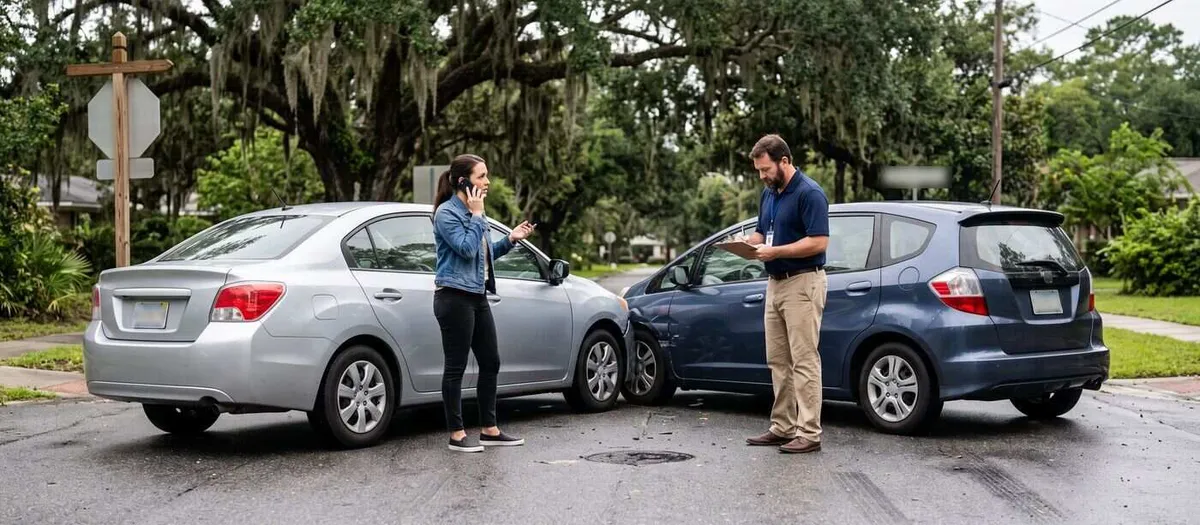
A driver runs a red light and hits you, but you were going five miles over the limit. A store leaves a spill in the aisle, but you were reading a text when you stepped in it. In most of the country, those details would shave a slice off your recovery. In North Carolina, an insurer can use them to argue you should recover nothing at all.
That is the practical effect of the state’s contributory negligence rule, and it shapes almost every injury case I handle in Wilmington and eastern North Carolina, from the first call with an adjuster to the final jury instruction. I’m Robert L Armstrong, and I have represented injury victims and their families for over 41 years. This guide walks through how the rule works, who has to prove it, the exceptions that can keep a claim alive, and how it plays out in car, pedestrian, slip and fall, and motorcycle cases.
How the 1% rule works in North Carolina
North Carolina follows pure contributory negligence. If you are hurt by someone else’s carelessness, and your own carelessness also helped cause the injury, you are generally barred from recovering anything for the other side’s ordinary negligence. There is no sliding scale. If you want the short version first, my plain-English basic definition covers the core idea in a few minutes.
People call it the 1% rule because the size of your share does not matter. A jury does not assign percentages in a North Carolina negligence case. It answers a yes-or-no question: was the injured person contributorily negligent? A yes on that question, even for a small lapse, can end the claim.
The burden of proof sits with the other side
The rule sounds harsh, and it is, but it comes with an important limit. Under G.S. 1-139, the party asserting contributory negligence has the burden of proving it. You do not have to prove you were perfectly careful. The at-fault driver or property owner, through their insurer and defense lawyer, has to produce evidence that you were negligent.
Your mistake has to be a proximate cause
Being imperfect is not enough. The defense also has to show that your negligence was a proximate cause of your injury, meaning it helped produce the harm in a natural, continuous sequence and the result was foreseeable. A driver with an expired inspection sticker, for example, made a mistake, but that mistake usually has nothing to do with why another car ran a stop sign into them. I look hard at this link in every case, because insurers often point to a real error that had no causal role.
Contributory negligence compared with the rules in other states
Most states abandoned this rule decades ago in favor of comparative fault, where a jury assigns percentages and reduces your recovery by your share instead of erasing it. Comparative fault comes in three main versions. Pure comparative fault lets you recover something even if you were mostly to blame. Modified comparative fault cuts you off at a set point, either when your share reaches 50% or when it reaches 51%.
The worked example below shows what that difference means for an injury victim with $100,000 in damages.

Here is where each rule applies, including the states closest to eastern North Carolina.
| Fault rule | How it works | Where it applies |
|---|---|---|
| Pure contributory negligence | Any proven fault that helped cause the injury can bar recovery | North Carolina, Virginia, Maryland, Alabama, and the District of Columbia |
| Pure comparative fault | Recovery is reduced by your share, at any percentage | Includes California, New York, and Kentucky |
| Modified comparative fault, 50% bar | Reduced by your share, barred at 50% or more | Includes Georgia, Tennessee, and Colorado |
| Modified comparative fault, 51% bar | Reduced by your share, barred at 51% or more | Includes South Carolina, Pennsylvania, and Texas |
That list matters for crashes near the state line. A wreck on the South Carolina side of US-17 can fall under South Carolina’s 51% bar, while the same wreck in Brunswick County falls under North Carolina’s rule. The District of Columbia has also carved out narrower treatment for some pedestrians and cyclists by statute, but North Carolina has made no similar change.
Exceptions that can keep a claim alive
Because the rule is so strict, North Carolina courts recognize several doctrines that soften it. The UNC School of Government summarizes recent appellate decisions on these doctrines in its Fault Lines overview, which is a useful plain-language read.
Last clear chance
Last clear chance applies when your own negligence put you in a position of helpless peril, the other party discovered or should have discovered you there, and they had the time and ability to avoid hurting you but negligently failed to do so. It fits moving-vehicle cases best, such as a driver who sees a stalled car or a pedestrian well ahead and keeps going. My separate guide to the last clear chance doctrine walks through each element with crash examples.
Gross negligence or willful and wanton conduct
Contributory negligence is a defense to ordinary negligence only. It does not bar recovery when the other side’s gross negligence, meaning wanton conduct done with conscious or reckless disregard for others’ safety, was a proximate cause of the injury. In car cases, North Carolina courts have pointed to three recurring patterns: an intoxicated driver, a driver at excessive speed, and a driver engaged in a race. One caution applies here. If the injured person was also grossly negligent, that can still bar recovery.
The sudden emergency doctrine
A person who faces a sudden emergency they did not create is judged by a less demanding standard. The question becomes whether they reacted the way a reasonable person would in the same emergency, not whether they made the wisest possible choice. If you swerved to avoid a car that pulled out in front of you and clipped something else, this doctrine can answer an argument that you should have braked instead.
Children and the age presumptions
North Carolina treats children differently, and the lines are specific. According to the notes to North Carolina’s pattern jury instruction on minors:
- A child under 7 is conclusively presumed incapable of contributory negligence.
- A child between 7 and 14 is presumed incapable, but the defense can try to rebut that presumption with evidence about the child’s capacity.
- A child 14 or older is presumed capable, and is held to the adult standard.
Even when a child between 7 and 14 is found capable, the child is judged against a reasonably careful child of the same age, experience, and capacity, not against an adult.
How the rule plays out in common injury cases
The rule is the same in every negligence case, but the arguments insurers raise change with the type of injury.
Car crashes
In crash cases, adjusters look for speed, a rolling stop, a late turn signal, or a moment of distraction. Phone records cut both ways here, which is why I cover distracted driving evidence early in a case. When three or more vehicles are involved, the analysis gets more layered, and I explain how shared fault works in multi-car crashes separately. For a Wilmington-specific walkthrough, I explain how the rule affects a local crash claim from the first adjuster call onward.
Pedestrian accidents
Pedestrian cases often turn on where the person was crossing. Under G.S. 20-174, a pedestrian crossing outside a marked crosswalk, or outside an unmarked crosswalk at an intersection, must yield to vehicles. The same statute also says every driver must still use due care to avoid hitting a pedestrian and take proper precaution around children. That second duty is often where last clear chance comes in. My page on pedestrian accidents covers these cases in more detail.
Slip and fall cases
Premises cases bring their own version of the argument, usually framed as an open and obvious hazard. In a 2024 decision, Cullen v. Logan Developers, the North Carolina Supreme Court reinstated summary judgment against a homeowner who stepped into an insulation-filled opening in her attic floor, reasoning that she would have seen it had she looked behind her. The five arguments stores and landlords raise most often are covered in my guide to slip and fall defenses.
Motorcycle crashes
Riders face a particular kind of bias. Adjusters often assume a motorcyclist was speeding or weaving, even when the real cause is a driver who turned left across the rider’s path without looking. Lane position, speed estimates, and visibility become the main points of dispute. I gather scene measurements and witness accounts early in motorcycle accidents so the claim does not rest on assumptions about riders.
How insurance adjusters use contributory negligence
Most contributory negligence fights start long before a lawsuit. They start with a phone call.
- Recorded statements. An adjuster’s friendly questions about speed, distance, and where you were looking are often designed to produce a single admission. I explain why I advise caution with recorded statements in a separate post.
- The seatbelt argument. Adjusters sometimes suggest that not wearing a seatbelt makes you partly at fault. G.S. 20-135.2A(d) says evidence of failure to wear a seat belt is not admissible in a civil trial, apart from narrow exceptions. My seatbelt guide covers this in more depth.
- Social media. A photo from a beach trip or a post saying you feel fine can be recast as evidence about the crash or your injuries.
- The police report. A citation or an officer’s note can be persuasive in negotiations, but the officer usually did not see the crash, and the report is one piece of evidence, not the final word.
The pattern is the same each time. The insurer only needs one fact that could support a finding of fault, and then it can offer a low number or deny the claim, betting the injured person will not want to test that argument in court.
Evidence that answers a contributory negligence defense
Because the defense carries the burden, the strongest response is usually evidence that leaves its argument without support. The items I go after first are:
- Video. Traffic cameras, business security systems, dashcams, and doorbell cameras, many of which are overwritten within days or weeks.
- Vehicle data. Event data recorders can show speed, braking, and throttle in the seconds before impact, which often answers a speeding claim directly.
- Scene evidence. Photographs of skid marks, debris, sight lines, lighting, and signage, along with measurements taken before the scene changes.
- Independent witnesses. People with no stake in the outcome, contacted while their memory is fresh.
- Phone records. Both sides’ records, preserved before carriers purge them on their normal schedule.
- Medical records. Consistent records that connect the injuries to the mechanism of the crash or fall, which blunt arguments about what really caused the harm.
None of this guarantees a particular result, and every case turns on its own facts. But a contributory negligence argument built on an adjuster’s assumptions is very different from one built on video and data, and the time to gather that evidence is early.
Contributory negligence FAQs
Does 1% of fault really end a personal injury case in North Carolina?
It can. If a jury finds that your own negligence was a proximate cause of your injury, even a small share of it, North Carolina’s contributory negligence rule bars recovery for ordinary negligence. The rule has exceptions, though, and the insurer has to prove your fault first. An adjuster saying you were partly to blame is not the same as a jury finding it.
Who has to prove contributory negligence?
The side raising it. Under G.S. 1-139, a party asserting contributory negligence has the burden of proving it. In practice, that means the at-fault driver’s or property owner’s insurer has to produce evidence that you were careless and that your carelessness helped cause the injury.
Can my child be found contributorily negligent?
It depends on age. North Carolina treats a child under 7 as incapable of contributory negligence. A child between 7 and 14 is presumed incapable, but the other side can try to overcome that presumption with evidence. A child 14 or older is presumed capable, the same as an adult.
Can the insurance company use my seatbelt against me?
Generally no. G.S. 20-135.2A(d) says evidence of failure to wear a seat belt is not admissible in a civil trial, with narrow exceptions that do not usually apply in an injury case. Adjusters still raise it in negotiations, so it helps to know the rule before that conversation.
I already told the adjuster I might have been going a little fast. Is my claim over?
Not necessarily. A recorded statement is evidence, but the insurer still has to show that your speed actually caused the crash, and exceptions like last clear chance or gross negligence may still apply. Bring me what you remember saying and the claim number, and I’ll look at how it fits with the rest of the evidence.
What does it cost to talk with you about a fault dispute?
The consultation is free, and there is no fee unless I win. Most North Carolina personal injury claims must be filed within three years, so it makes sense to find out where you stand on fault well before that deadline.
Talking to a Wilmington injury lawyer about fault
Contributory negligence is the reason a small detail can carry so much weight in a North Carolina injury claim, and the reason I treat every fault argument as something the other side has to prove. I handle each case personally, from the first look at the evidence through negotiations and, when needed, trial. I represent injury victims and their families across New Hanover, Brunswick, Pender, Onslow, Bladen, and Duplin counties. The consultation is free, and there is no fee unless I win.
This post is general information, not legal advice for your specific situation. If an insurer has already suggested you share the blame for a crash or fall, Talk to a Wilmington injury lawyer before you accept that version of events.
The insurer has to prove your fault, not the other way around.
North Carolina puts the burden of proving contributory negligence on the side raising it. Get a free review of the evidence, the exceptions that may apply, and what the adjuster is likely to argue.
Related Articles

Contributory Negligence in Wilmington Car Accident Cases
Learn how contributory negligence can affect your Wilmington car accident case. Protect your rights and get help maximizing your compensation. Call today.

What Is Contributory Negligence?
Learn what contributory negligence means in North Carolina and how it could bar your injury claim if you're found even 1% at fault. Get legal help today.
NC's Last Clear Chance Rule in Car Accidents
North Carolina's last clear chance rule can rescue a claim that contributory negligence would otherwise bar. How it works and when it applies.