Texting and driving accident NC law and phone records

On this page
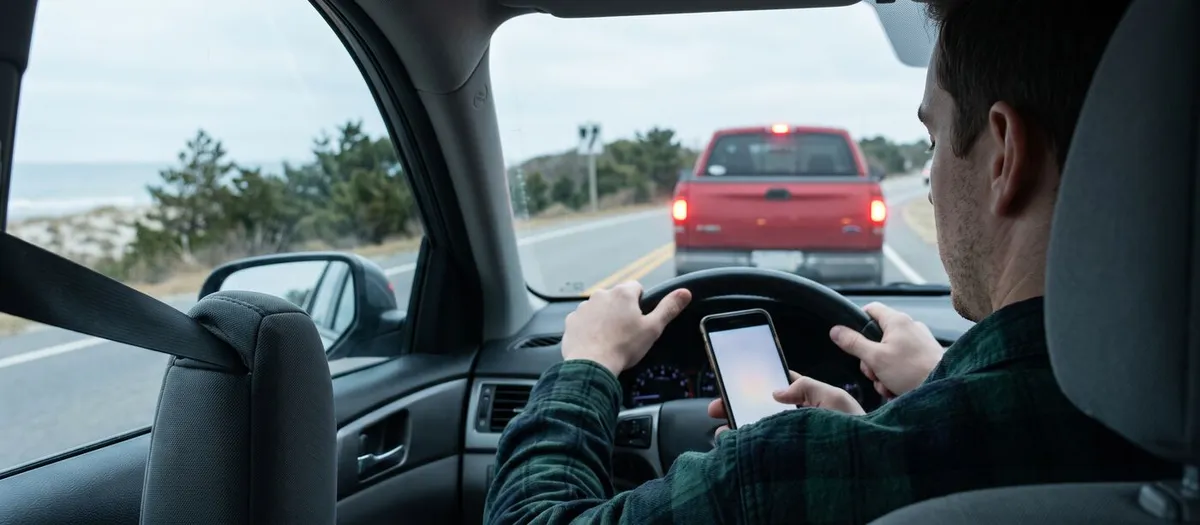
A driver glances down to answer a text on Market Street, looks up a few seconds later, and your car is already crumpled in front of theirs. Phone-distracted crashes like this happen across eastern North Carolina every week, and they leave injury victims and their families with a hard question: how do you prove what was in the other driver’s hand?
The answer starts with a short statute most people have never read, plus a set of records that sit with phone companies, store owners, and car makers on their own schedules. I’m Robert L Armstrong, and I have represented injury victims and their families in the Wilmington area for over 41 years. This guide covers what North Carolina’s law actually prohibits, one sentence in that law that changes how a civil claim works, and the evidence that shows a driver was using a phone at the moment of impact.
What North Carolina’s texting law actually prohibits
Many of the phone cases I see start as rear-end collisions at a light or in slowing traffic, and the first question is what the law says the other driver couldn’t do. North Carolina’s main distracted driving statute is G.S. 20-137.4A. It makes it unlawful to operate a vehicle on a public street, highway, or public vehicular area (a parking lot counts) while using a mobile phone to do either of two things:
- Manually type multiple letters or text into the phone to communicate with another person.
- Read any email or text message sent to or stored on the phone.
Looking at a stored name or number, or at caller ID, is not covered. A voice call is not covered either. For most adult drivers in North Carolina, holding a phone to your ear and talking is still legal.
The exceptions in the statute
The law does not apply to a driver who is lawfully parked or stopped. It also exempts law enforcement officers, firefighters, and ambulance operators on duty, GPS systems (factory-installed or aftermarket), wireless devices used as part of a digital dispatch system, and voice-operated technology. Those exceptions matter in a crash case, because the other driver’s first explanation is often “I was only using the map.”
The penalty is small
A violation is an infraction with a $100 fine plus court costs. There are no license points and no insurance surcharge. For a school bus driver, a violation is a Class 2 misdemeanor with a fine of at least $100.
The sentence in G.S. 20-137.4A that changes an injury claim
The last sentence of the statute is the one I explain most often. It says failure to comply with the law “shall not constitute negligence per se or contributory negligence per se” in any lawsuit over damages from a vehicle crash.
Negligence per se is a legal shortcut. In many situations, breaking a safety law counts as proof of carelessness on its own. The texting statute switches that shortcut off. So even when the other driver was cited for texting, the citation does not automatically establish fault in a civil case. I still have to show two things with evidence: the driver was not keeping a reasonable lookout and control of the vehicle, and that failure caused the crash.
That doesn’t make phone use irrelevant. Texting can still be strong evidence that a driver wasn’t paying attention, and a jury can weigh it alongside everything else. It just means the case has to be proven with facts rather than with the ticket. That is why the evidence sections below matter more than the citation itself.
The same sentence protects the injured driver. If the insurer claims you were texting, it can’t treat that as automatic contributory negligence either. It has to prove your phone use actually contributed to the crash.
The three types of distraction behind phone crashes
The CDC groups distracted driving into three types: visual (eyes off the road), manual (hands off the wheel), and cognitive (mind off driving). Texting is the rare activity that does all three at once. NHTSA’s estimate is that reading or sending a text takes your eyes off the road for about 5 seconds, which at 55 mph covers the length of a football field.
This framework helps when the evidence is mixed. A driver using a mounted phone for navigation may avoid the manual piece, but tapping a screen to change a route still takes eyes off the road. A hands-free call can still be cognitive distraction. North Carolina’s texting law doesn’t reach every one of these, but a negligence claim can, because the question in a civil case is whether the driver used reasonable care, not only whether they broke a specific statute.
The numbers in North Carolina are real. NC Vision Zero, the traffic safety program at NC State’s Institute for Transportation Research and Education, reports that distracted driving crashes killed 147 people and injured 19,230 on North Carolina roads in 2024, citing NCDOT crash data.
Other phone rules that can apply after a crash
Drivers under 18
G.S. 20-137.3 is much broader than the adult texting law. A driver under 18 may not use a mobile phone at all while the vehicle is moving, including hands-free calls, music, internet, and games. The exceptions are calls to emergency services or a hospital or doctor’s office, and calls to the teen’s parent, legal guardian, or spouse. The fine is $25. With National Teen Driver Safety Week running October 18 to 24, this is a good time for families to review it. Parent liability in teen driver crashes is its own subject, which I cover in a separate guide.
School bus drivers
Under G.S. 20-137.4, a school bus driver may not use a mobile phone while the bus is moving, except to communicate in an emergency. A violation is a Class 2 misdemeanor. Like the texting law, this statute says a violation is not negligence per se.
Truck drivers and other commercial drivers
Federal rules go further than North Carolina’s. Drivers of commercial motor vehicles may not text while driving under 49 CFR 392.80, and may not hold a mobile phone while driving under 49 CFR 392.82, including while stopped briefly in traffic or at a light. Motor carriers may not allow or require their drivers to do either. North Carolina adopted those federal limits into G.S. 20-137.4A(a1). When a truck crash involves phone use, the trucking company’s own phone policy, dispatch messages, and in-cab data become part of the case.
Rideshare drivers
Uber and Lyft drivers are regular drivers under North Carolina law, so the adult texting rules apply to them. Their phones are also their work tools, which means the app’s trip log and timestamps can show when a ride request was accepted or a screen was tapped. Expect the defense to argue that app activity falls under the GPS or digital dispatch exceptions. In a rideshare crash, I look at that app data alongside the phone records.
The status of a hands-free law in North Carolina
As of October 2026, North Carolina does not have a hands-free law. Two bills titled Hands Free NC have been filed in the current session, Senate Bill 526 in March 2025 and Senate Bill 797 in April 2026, and both were referred to the Senate Rules Committee without a vote. Late in 2025, a viral post claimed a hands-free law had taken effect, and a fact check by WRAL and PolitiFact confirmed it had not. I update this page if that changes.
Evidence that shows the phone was in their hand
No single record proves texting. A strong case puts several sources side by side, each covering a gap in the others. Many of the scene-level steps are covered in my guide to scene evidence after a texting crash. Here is how the main record types compare.
| Evidence type | What it shows | How long it’s kept | How it’s usually obtained |
|---|---|---|---|
| Carrier records | Time and number of calls and SMS texts, and data sessions | Varies by carrier | Subpoena after suit is filed |
| Device forensic exam | App activity, screen unlocks, messages sent or read | Until deleted or overwritten | Discovery request or court order |
| Vehicle data (EDR and infotainment) | Speed, braking, and phone pairing or call logs | Until overwritten or the car is repaired or salvaged | Preservation letter, then inspection |
| Camera footage | Head position, hands, and lane drift before impact | Varies by owner, often overwritten | Request to the business or public agency |
| Witness accounts | What other drivers and passengers saw | Memory fades quickly | Early interviews and written statements |
| Social media timestamps | Posts, comments, or messages near the crash time | Until deleted | Screenshots, then a discovery request |
Carrier records and device forensics are different things
Carrier records usually show when calls and SMS texts were sent and received, not what they said. They often miss messages sent through apps like iMessage, WhatsApp, or Snapchat, because those travel as data. A forensic exam of the phone itself can show far more, including which app was open, when the screen was unlocked, and whether a message was typed or read in the seconds before impact. Courts weigh the driver’s privacy against the need for the data, so requests are usually limited to a narrow window around the crash time.
Preservation letters and subpoenas
Before a lawsuit, a preservation letter puts the driver and their insurer on notice to keep the phone, the account, and the data. Deleting evidence after that notice can lead to a court instruction that lets the jury assume the deleted material would have hurt the driver. Subpoenas to carriers generally require a pending lawsuit, which is one reason the early letter matters.
Vehicle data, cameras, and witnesses
A car’s event data recorder can show whether the driver braked before impact, and the infotainment system may log a paired phone’s calls and messages. Store cameras, traffic cameras, and dashcams can catch a driver’s head down for several seconds, and my guide to traffic camera footage explains how those requests work. Witnesses who saw a phone in someone’s hand are worth contacting early, before memories fade.
Step-by-step evidence timeline after a texting crash
Here is the order I generally follow. Every case is different, but the sequence matters because each step protects the next one.
- Day of the crash. Photograph the other driver’s seat area and any visible phone, collect witness contact information, and tell the officer what you saw so it’s noted in the crash report.
- First week. Send preservation letters to the other driver and their insurer, and ask nearby businesses to save camera footage covering the crash time.
- First month. Request the crash report and 911 audio, gather the injured driver’s own phone records, and note the exact crash time from every source.
- In the lawsuit. Subpoena carrier records for a narrow window around the crash, and request a forensic exam of the phone if the records point to use.
- Expert review. Line up message times, app activity, and vehicle data against the crash time, second by second.

How the insurer turns distraction back on the injury victim
North Carolina is one of the few places where strict contributory negligence still applies to car crashes. If the injured driver is found even slightly at fault, recovery can be barred completely. Insurers know this, and in phone cases they often ask for the injured driver’s records first.
The argument usually sounds like this: you were checking a notification, so you didn’t react in time to avoid the car that drifted into your lane. Whether it holds up depends on timing. A text that arrived on your phone a minute before the crash is not the same as a message you were typing at impact. This is why I gather my own client’s records early and match them to the crash time, rather than waiting for the insurer to pick out a single timestamp and build a story around it. North Carolina’s last clear chance doctrine can sometimes answer a contributory negligence defense, but it has strict elements, and it only helps when the facts are documented.
Don’t give a recorded statement about your own phone use before you understand how it can be used. A casual “I might have glanced at it” can become the center of the defense.
Texting and driving accident FAQs
Is it illegal to text and drive in North Carolina?
Yes. G.S. 20-137.4A makes it unlawful to type multiple letters or text to communicate with someone, or to read a text or email, while operating a vehicle on a public street, highway, or public vehicular area. The fine is $100 plus court costs, with no license points or insurance surcharge. Drivers who are lawfully parked or stopped are exempt, as is voice-operated technology.
Is it legal to talk on a handheld phone while driving in NC?
For most adult drivers, yes, as of October 2026. North Carolina’s texting law covers typing and reading messages, not voice calls. Drivers under 18 may not use a phone at all while the car is moving, school bus drivers may not use one while the bus is in motion, and commercial truck drivers fall under the federal hand-held phone ban. Hands-free bills have been filed in the General Assembly but none has passed.
If the other driver got a texting ticket, does that prove my case?
Not on its own. The texting statute says a violation is not negligence per se, so the citation doesn’t automatically establish fault in a civil case. The ticket is still useful because it shows the officer saw evidence of phone use. I still have to show the phone use was careless driving that caused the crash, which is where phone records, vehicle data, and witnesses come in.
Can I get the other driver’s phone records without a lawsuit?
Usually not. Phone carriers generally won’t release a customer’s records to another driver or insurer without consent or a subpoena, and a subpoena typically requires a pending lawsuit. Before suit, I send preservation letters asking the driver and their insurer to keep the phone and its data. Once suit is filed, the records can be subpoenaed and the phone requested in discovery.
What if the insurer says I was on my phone too?
Take it seriously, because North Carolina’s contributory negligence rule can bar recovery if the injured driver is found even slightly at fault. The same statute that protects the other driver from automatic fault protects you too, so the insurer has to prove your phone use actually contributed to the crash. I pull my own client’s records early so the timeline is documented before the insurer builds its version.
How much does it cost to talk to you about a texting crash?
The consultation is free, and there is no fee unless I win. I explain how case costs are handled during that first conversation, before you decide anything.
Talking to a Wilmington car accident lawyer about a texting crash
A texting crash case in North Carolina rarely turns on the ticket. It turns on whether the phone records, vehicle data, cameras, and witnesses line up with the moment of impact, and on whether those records were preserved before the companies holding them overwrote them. If you’re still sorting out the first days after a crash with a texting driver, the order of steps above is a good place to start.
I handle these cases personally and work with injury victims and their families across New Hanover, Brunswick, Pender, Onslow, Bladen, and Duplin counties. The consultation is free, and there is no fee unless I win. This page is general information, not legal advice for your situation. When you’re ready to talk through what happened, Talk to a Wilmington car accident lawyer.
Phone evidence is kept on someone else's schedule.
Carrier records, store cameras, and vehicle data are kept on schedules the injured family doesn't control. Have preservation letters go out early, before the records you need are gone.
Related Articles
Prove Other Driver Was Texting in a Wilmington, NC Car Crash
Prove the other driver was texting in your Wilmington, NC car crash. Learn key steps and evidence. Call Robert Armstrong for a free consultation.

Texting Driver in Wilmington Car Accident – What to Do Next
Was the at-fault driver texting in your Wilmington car accident? Learn how to prove it and protect your rights. Call Robert L Armstrong for help.

Teen driver car accident and parent liability NC
A Wilmington teen driver crash can put a parent's own policy on the hook under NC's family purpose doctrine. Get a free consultation, with no fee unless I win.