Cape Fear River boating accident claims and maritime law

On this page
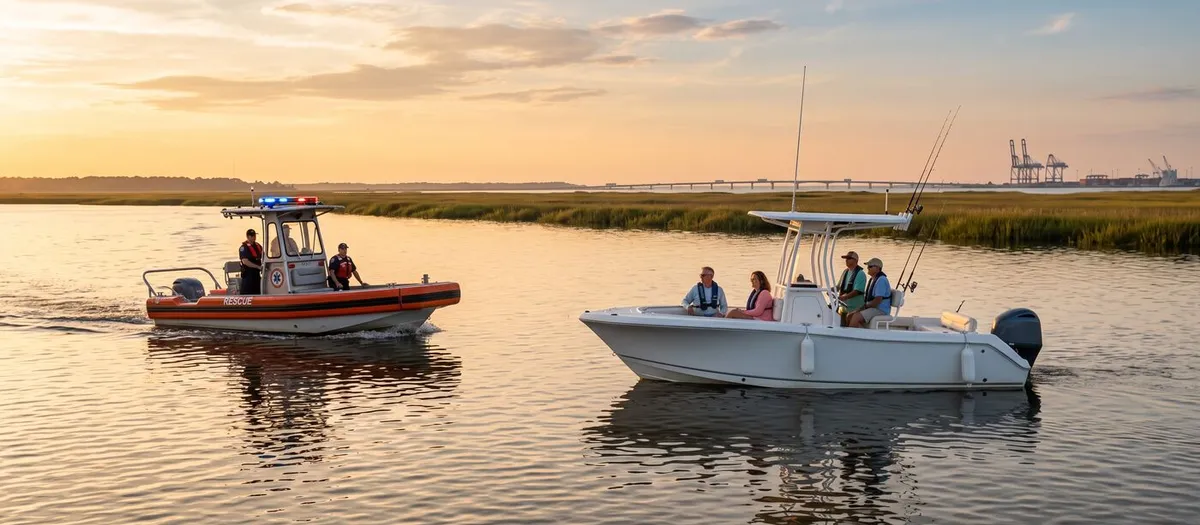
A day on the water around Wilmington can mean a run down the Cape Fear River past the Port of Wilmington, a trip through Snows Cut to Carolina Beach, or an afternoon anchored near Masonboro Island. When a boat, jet ski, or tube ride goes wrong in those places, the injuries can be severe, and the legal questions afterward are different from anything a car crash raises. The first question is often the most surprising one: which body of law even applies?
On navigable waters like the Cape Fear River and the Intracoastal Waterway, federal maritime law may govern an injury claim instead of ordinary North Carolina law. That can change the fault rule, the filing deadlines, and how much a boat owner is able to limit what they pay. I’m Robert L Armstrong, and I have represented injury victims and their families in eastern North Carolina for over 41 years. This guide walks through what happens after a boating accident on local waters, step by step, so you know what to expect before an insurer calls.
Why boating accidents happen on the Cape Fear River and the ICW
The injuries in these cases are often serious: near drowning, propeller wounds, broken bones, and head trauma from being thrown against a console or into the water. National numbers explain how these accidents start. In its 2024 report, the U.S. Coast Guard counted 3,887 recreational boating incidents, 556 deaths, and 2,170 injuries across the country. Operator inattention, improper lookout, operator inexperience, machinery failure, and navigation rules violations were the top five primary contributing factors in those incidents, according to the Coast Guard’s statistics. Alcohol was the leading known factor in fatal incidents, listed as the primary cause in 20% of deaths where the cause was known.
Local waters add their own hazards on top of those national causes. These are the conditions I see come up again and again when a boating injury happens near Wilmington.
| Local waterway | Common hazard | Why it leads to injuries |
|---|---|---|
| Cape Fear River shipping channel | Large commercial ships and tugs heading to and from the Port of Wilmington | Big vessels cannot stop or turn quickly, and their wakes can swamp or flip a small boat |
| Snows Cut and the ICW near Carolina Beach | Narrow channel, shoaling, and heavy weekend traffic | Boats pass close together, and shallow spots outside the channel can ground a boat without warning |
| Masonboro, Mason, and Carolina Beach inlets | Strong tidal currents and breaking waves | Currents push boats off course, and inexperienced operators lose control near the bars |
| Wrightsville Beach and Banks Channel | Jet skis, rental boats, paddleboards, and swimmers sharing tight space | Speed near swimmers and no-wake areas causes collisions and propeller injuries |
| Southport and Bald Head Island | Ferry traffic, fast tides at the river mouth, and sandbars | Operators unfamiliar with the area misjudge depth and current |
Wake injuries deserve a special mention. A boat throwing a large wake through a no-wake zone can toss passengers on another vessel against hard surfaces, knock a tuber off a tow line, or slam a person on a dock. The boat that caused the wake may keep going without anyone realizing what happened behind it. North Carolina defines no-wake speed as idle speed or slow speed creating no appreciable wake, and posted no-wake zones around marinas, ramps, and bridges are common on the ICW.
Steps to take after a boating accident on local waters
The hours after a boating accident are chaotic, especially when someone is in the water. These steps keep people safe first and then protect the evidence a claim depends on.
Get everyone out of the water and call for help
Account for every person on board, get anyone in the water back on a boat, and call 911 or hail the Coast Guard on VHF channel 16. Put life jackets on anyone who isn't wearing one.
Get medical care, even for injuries that seem minor
Head injuries, near drowning, and spinal injuries can look minor at first. A medical record made the same day connects your injuries to the accident.
Exchange information with the other operator
Write down the other operator's name, address, and the boat's registration number. North Carolina law requires an operator involved in an accident to provide this in writing.
Document the scene before it changes
Photograph both boats, the damage, the location, any markers or buoys nearby, and the water and weather conditions. Note the time and tide if you can.
Make sure the accident is reported
Injuries, deaths, and damage of $2,000 or more trigger a report to the NC Wildlife Resources Commission. Ask the responding officer for the report number.
Be careful with insurance calls
Report the accident to your own insurer, but avoid recorded statements to the other side's adjuster until you understand which law applies to your claim.

That last step matters more on the water than on land. Adjusters often ask how fast you were going, whether anyone had been drinking, and who was watching the bow. Short, early answers to those recorded statements can follow a claim for months, so I suggest keeping your own written notes instead.
Reporting a boating accident in North Carolina
North Carolina’s Boating Safety Act, found in Chapter 75A of the General Statutes, sets out what an operator has to do after an accident. Under G.S. 75A-11, the operator must give whatever help is practical to anyone hurt, as long as doing so doesn’t put their own boat and passengers in serious danger. The operator must also give their name, address, and vessel identification in writing to anyone injured and to the owner of damaged property. The federal rule at 33 CFR 173.55 uses the same thresholds, and North Carolina collects these reports for the Coast Guard.
| What happened | NC report to Wildlife Resources Commission (G.S. 75A-11) | Federal rule (33 CFR 173.55) |
|---|---|---|
| A person dies or disappears | Notify law enforcement without delay, then file a report within 48 hours | Report within 48 hours |
| A person is injured | File within 48 hours | Within 48 hours if treatment beyond first aid is needed |
| Damage of $2,000 or more | File within 10 days | Within 10 days |
| Complete loss of a boat | File within 10 days | Within 10 days |
| Operator can’t file | The owner files the report | The owner files the report |
One detail surprises people. Under G.S. 75A-11(b), the written report an operator files with the Commission is not admissible as evidence. That doesn’t make the accident a dead end for proof. Officer notes, witness accounts, photos, phone records, GPS data from chartplotters, and marina camera footage can all still come in. I start gathering those sources early because many of them are overwritten on a routine schedule.
North Carolina boating laws that matter in an injury claim
A broken safety rule doesn’t decide a claim by itself, but it is often strong evidence of carelessness. These are the boating safety statutes I check first after a crash on local waters.
Boating while impaired
Under G.S. 75A-10(b1), it is illegal to operate a vessel underway while under the influence of an impairing substance or with an alcohol concentration of 0.08 or more. G.S. 75A-10.3 makes it a felony to cause serious injury or death while boating impaired. A criminal case and an injury claim run separately, but the toxicology results and officer observations from the criminal side often become key evidence in the civil case.
Boater education
G.S. 75A-16.2 requires anyone operating a boat with a motor of 10 horsepower or more to meet the state’s boating safety education requirement. People born before January 1, 1988, are exempt. So is a person holding a rental agreement that lists them as the authorized operator. That means the person driving a rented pontoon boat near you may never have taken a boating course at all.
Life jackets for children
North Carolina requires anyone younger than 13 to wear an appropriate life jacket on a recreational vessel that is underway, as the NC Wildlife Resources Commission explains. Everyone riding a personal watercraft, or being towed behind one, must wear a Coast Guard approved life jacket, and inflatable vests don’t count.
Personal watercraft rules
Under G.S. 75A-13.3, no one under 16 may operate a jet ski unless they are at least 14 and either have a boating safety card or ride with an adult 18 or older who meets the education requirement. Jet skis may not run between sunset and sunrise, and they must stay at no-wake speed within 100 feet of docks, anchored boats, swimmers, and marked swimming areas outside a narrow channel. A rental business may not rent a jet ski to anyone under 16 outside those exceptions, and it has to give each renter basic safety instruction.
The family purpose doctrine applies to boats
Most people know North Carolina’s family purpose doctrine from car cases. G.S. 75A-10.1 extends it to boats, so a parent who keeps a boat for the family’s general use may be responsible when a family member operates it carelessly. That can bring the owner’s insurance into a claim even when the owner wasn’t on board.
When federal maritime law applies to a Cape Fear River boating accident
This is the part of a boating case that most often changes the outcome. In Foremost Insurance v. Richardson, the U.S. Supreme Court held that a collision between two pleasure boats on navigable waters falls within federal admiralty jurisdiction, even though neither boat was used for commerce. The Cape Fear River and the Intracoastal Waterway are navigable waters that carry commercial traffic. That means a collision, a wake injury, or a passenger injury on those waters may be governed by general maritime law, depending on the facts.
The biggest practical difference is the fault rule. North Carolina follows contributory negligence, which can bar an injured person from recovering anything if they were even slightly at fault. General maritime law uses pure comparative fault instead. Under that rule, a court reduces an injured person’s recovery by their share of the blame. Someone found 20% at fault for a collision on the ICW may still recover 80% of their damages under maritime law, while the same facts on a state-law claim could mean no recovery at all.

Workers are a separate category. A crew member injured on a charter boat, tug, or commercial fishing vessel may have claims under the Jones Act and related seaman remedies, which follow their own rules. This guide focuses on recreational boaters, passengers, and people hurt by someone else’s boat.
Who may be liable for a boating injury
Boating accidents often involve more than one responsible party. The operator is the obvious one, but the owner, a rental business, or a manufacturer may share responsibility. This table shows the parties I look at and the evidence that tends to prove each claim.
| Party | Why they may be liable | Evidence that helps prove it |
|---|---|---|
| Boat operator | Speeding, inattention, no lookout, impairment, or breaking navigation rules | Witness accounts, BWI arrest records, GPS track, photos of the scene |
| Boat owner | Family purpose doctrine, or lending the boat to someone they knew was inexperienced or impaired | Registration, who usually ran the boat, the operator’s history |
| Rental company (livery) | Renting to an underage or unqualified operator, skipping safety instruction, or poor maintenance | Rental contract, instruction records, maintenance logs, staff statements |
| Charter or tour captain | Unsafe operation, overcrowding, or running in bad weather | Passenger count, captain’s license, weather data, trip logs |
| Marina or dock owner | Unsafe docks, poor lighting, or hazards near fuel and launch areas | Inspection records, prior complaints, photos of the hazard |
| Manufacturer | A defective hull, steering, throttle, kill switch, or fuel system | The boat or part itself, recall notices, expert inspection |
| Another boat | Its own operator’s careless driving or a large wake | Damage patterns, witness statements, marina or bridge cameras |
Under G.S. 75A-8, a vessel livery may not rent a boat unless the requirements of the Boating Safety Act have been met, and every rented boat must carry the required equipment. That gives injury victims a clear standard to measure a rental business against.
Insurance coverage for boating accident injuries
Insurance is where many boating claims stall. North Carolina does not require private boat owners to carry liability insurance, though marinas and lenders often do. A homeowners policy may exclude boats entirely or cover only small boats with low horsepower, so the coverage available after a serious injury can be much thinner than on a car crash.
There is one important exception. G.S. 75A-13.3 requires any business renting personal watercraft to the public to carry liability insurance covering both the business and the renter, with a minimum limit of $300,000 per occurrence. If a rented jet ski hits you near Wrightsville Beach or Carolina Beach, that policy may be a source of recovery.
Some boat policies offer uninsured boater coverage, which works much like uninsured motorist coverage on a car. If the boat that hit you had no insurance, your own policy may still respond. I ask every client for their boat, homeowners, and umbrella declarations pages early, because the right coverage often isn’t obvious.
Filing deadlines for a boating injury claim
The deadline depends on which law governs, and a boat owner’s ability to limit liability creates a second clock that many people never hear about.
- Maritime claims: A personal injury or death claim arising from a maritime tort generally must be filed within 3 years under 46 U.S.C. 30106.
- North Carolina claims: Most personal injury claims must be filed within 3 years under G.S. 1-52, and most wrongful death claims within 2 years under G.S. 1-53.
- Limitation of liability: Under the Limitation of Liability Act, now at 46 U.S.C. 30529 after the 2022 renumbering, a vessel owner may file a federal action within 6 months after receiving written notice of a claim. If the court allows it, the owner’s liability may be capped at the value of the boat after the accident, and other claims against the owner stop while the case proceeds.
When a boating accident takes a life, the family’s claim follows its own rules on who may bring it and what damages are available. My wrongful death practice handles those cases with the same attention to which law applies.
How a boating injury claim moves forward
Every case is different, but most boating claims I handle follow a similar path. Here is what that usually looks like.
Free consultation and case review
I listen to what happened, review photos and medical records, and look at where the accident took place to see whether maritime or North Carolina law likely applies.
Evidence preservation
I send preservation letters for GPS data, camera footage, rental records, and phone records, and I request the Wildlife Resources Commission and officer reports.
Insurance investigation
I identify every policy that may apply, including boat, homeowners, umbrella, rental, and charter policies, along with your own uninsured boater coverage.
Medical documentation and damages
As treatment continues, I document medical bills, lost income, future care, and how the injury affects daily life, then prepare a written demand.
Negotiation or lawsuit
Many claims resolve through negotiation. If the insurer won't make a fair offer, I file suit in the right court before the deadline that applies.
A brain injury or spinal injury from a boating accident can take weeks to show its full effects, so I don’t recommend resolving a claim until the medical picture is clear. Boaters also face storm-season risks on top of everyday hazards, which I cover in my guide to hurricane season liability.
Cape Fear River boating accident FAQs
Does maritime law apply to every boating accident near Wilmington?
No. Federal maritime law generally applies when an accident happens on navigable waters, such as the Cape Fear River or the Intracoastal Waterway, and the incident has a real connection to traditional maritime activity, like operating a vessel. A collision between two recreational boats on the ICW often meets that test. An injury on a private pond or on a dock at the edge of the water may not. Which law applies depends on the facts, and I look at that question early in every boating case I review.
Can I still recover if I was partly at fault for the boating accident?
Possibly. If maritime law applies, a court reduces your recovery by your percentage of fault instead of barring it. If North Carolina law applies instead, the contributory negligence rule can bar recovery when an injured person is found even slightly at fault. That difference is one of the main reasons I sort out which law governs before talking numbers with any insurer.
I was a passenger on a friend’s boat. Can I make a claim without ruining the friendship?
Many passenger claims are paid by the boat owner’s insurance policy, not by the owner personally. The claim is often a conversation between my office and an insurance company. I understand the hesitation, and it’s something I talk through with injury victims and their families during the free consultation.
What if the boat that hit us left the scene?
North Carolina law requires an operator involved in an accident to stop, help anyone who is hurt, and give their name, address, and vessel identification in writing. Leaving the scene can be a violation on its own. Report it to the NC Wildlife Resources Commission or local law enforcement right away, and write down the boat’s registration number, color, size, and direction of travel if anyone saw it.
Who pays my medical bills after a jet ski rental accident in Wrightsville Beach or Carolina Beach?
Your own health insurance usually pays first. North Carolina requires businesses that rent personal watercraft to carry liability insurance of at least $300,000 per occurrence covering both the business and the renter, so that policy may be available if the rider or the rental company was negligent. The rental contract and any waiver you signed matter too, and I read both before giving an opinion.
How much does it cost to talk to you about a boating accident?
The consultation is free, and there is no fee unless I win. Case costs and how they are handled are explained in writing before you sign anything with my firm.
Talking to a Wilmington lawyer about your boating accident
A boating accident on the Cape Fear River, in Snows Cut, or near the inlets at Wrightsville Beach and Carolina Beach can raise questions most injury claims never touch: whether admiralty jurisdiction applies, whether the owner will try to limit liability, and which insurance policies cover a boat or a rented jet ski. I handle each case personally and work with injury victims and their families across New Hanover, Brunswick, Pender, Onslow, Bladen, and Duplin counties. The consultation is free, and there is no fee unless I win.
If you or someone in your family was hurt on the water, talk to a Wilmington boating accident lawyer before you send a written claim to the boat owner or their insurer, and well before the filing deadline.
A boat owner may try to cap what you can recover.
After a written claim, a vessel owner has six months to ask a federal court to limit liability to the value of the boat. Know where your case stands before that first letter goes out, and have the claim, the evidence, and the deadlines handled for you.
Related Articles
Hydroplaning accident in NC and who is at fault
A hydroplaning crash in eastern NC is usually blamed on speed, but hidden water, king tides, and road defects can shift fault. Ask about a free consultation.
Hurricane-Season Car Accidents in NC: Who's Liable?
Hurricane-season car accidents in NC: how weather affects fault, insurance, and contributory negligence. What eastern NC drivers need to know.
Contributory negligence in North Carolina and the 1% rule
In Wilmington and eastern NC, 1% of fault can bar an injury claim. See a $100,000 worked example, the exceptions, and a state-by-state chart. Free consultation.