Hydroplaning accident in NC and who is at fault

On this page
A car that loses traction in standing water on US-17, Carolina Beach Road, or a low stretch of Market Street can cross a lane in a second. When the rain stops, the first question every insurer asks is whether the driver was going too fast for a wet road. The answer to that question decides most injury claims that start with a skid.
I represent injury victims and their families in Wilmington and the surrounding counties, and after over 41 years of practice I see flooded-road crashes follow a familiar pattern. Fault analysis starts with the driver who lost control, and then the facts about the water, the road, and the other drivers either confirm that or undo it. This guide explains how that works in North Carolina, what king tides and chronic drainage problems add, and where a road-defect claim against a public agency fits in.
Who is liable when a car hydroplanes in North Carolina?
In most cases, the driver whose car hydroplaned is treated as the driver at fault. Hydroplaning happens when a layer of water builds up between the tires and the pavement faster than the tread can push it away, and the tires lose contact with the road. Insurers and courts see that loss of control as evidence that the driver was traveling faster than the road conditions allowed, the same way they treat skids in hurricane-season crashes along the coast.
The legal basis is a short sentence in the speed statute. NCGS 20-141 bars driving “at a speed greater than is reasonable and prudent under the conditions then existing.” That means a driver can be under the posted limit and still be speeding in the legal sense. Going 55 in a 55 zone during a summer downpour on I-140 can be a violation if the water on the road called for 35.
This standard is why the weather box on a police report rarely helps the driver who skidded. Rain describes the conditions, and the speed statute asks whether the driver adjusted to them.
That default is strong, but it is only a starting point. The rest of this guide covers the facts that can move fault somewhere else.
At what speed does hydroplaning happen?
There is no single speed at which hydroplaning starts. It depends on the depth of the water, the depth of the tire tread, tire pressure, the weight of the vehicle, and the texture of the road surface. Worn tires on a light car can lose grip in a shallow sheet of water at ordinary city speeds, while new tires on a heavy truck hold longer.
That variability matters in a claim. When an insurer argues that a driver “should have known” to slow down, the answer depends on what the driver could see. A visible sheet of water across both lanes supports the insurer. A shallow puddle that looked like wet pavement until the tires hit a deeper pocket supports the driver. Tire condition also comes up, because bald tires can shift part of the blame to the driver who kept them on the car, or to a shop that said they were fine.
Deep water is a separate problem. The National Weather Service’s flood safety guidance warns that 12 inches of rushing water can carry away most cars and 2 feet can carry away SUVs and trucks. A crash in water that deep is usually less about hydroplaning and more about whether anyone should have been driving into it at all.
Standing water and king tides on coastal roads
Much of the flooding I see in crash files around Wilmington does not come from hurricanes. It comes from ordinary thunderstorms dumping rain on roads with poor drainage, and from high tides pushing water up through storm drains in low-lying areas near the Cape Fear River and the sounds.
NOAA describes a king tide as an informal term for exceptionally high tides, which tend to occur around new and full moons and during certain seasons. On the coast, those tides can put water across a road on a clear day. Drivers who are not expecting water under a blue sky are more likely to hit it at normal speed, which is one reason sunny-day flooding crashes deserve a careful look at what the driver could reasonably see.
Some of the recurring trouble spots are well known to locals. Streets near downtown Wilmington’s riverfront, the approaches to Carolina Beach along Lake Park Boulevard, and low roads in Brunswick County near the Intracoastal Waterway all take on water during heavy rain or high tide. A location that floods again and again matters legally, because repeated flooding is how a public agency comes to know about a hazard.
When the hydroplaning driver is not the only one at fault
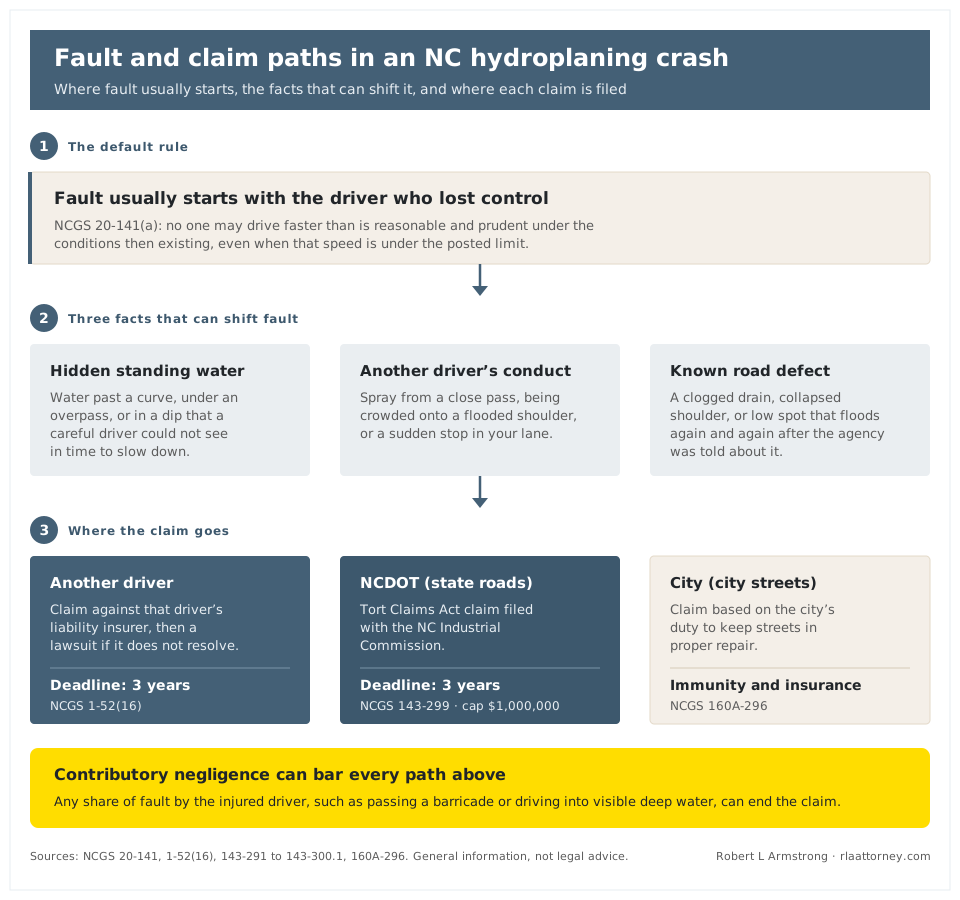
The default against the driver who lost control can give way when the evidence shows something else caused or contributed to the crash. Three patterns come up most often in my files, and the infographic below lays them out with the claim path each one tends to open.
The first is hidden water. If standing water sat just past a curve, beneath an overpass, or at the bottom of a dip where a driver could not see it in time, the argument that the driver should have slowed down gets much weaker. Photos taken from the driver’s line of approach are the best evidence of what was visible.
The second is another driver’s conduct. A driver who passes too closely and throws a wall of spray across your windshield, crowds you onto a flooded shoulder, or stops suddenly in your lane can share or carry the fault. North Carolina also recognizes a sudden emergency doctrine, which asks whether a driver who faced an emergency they did not create responded the way a reasonable person would.
The third is the road itself. A clogged storm drain that a maintenance crew was told about, a collapsed shoulder that funnels water into the travel lane, or a paving job that left a low spot where water always pools can point to the agency responsible for the road. Even when this is true, the driver-versus-driver claim often still runs alongside the road claim.
Contributory negligence and flooded roads
North Carolina is one of a handful of places that still follows contributory negligence, a rule that bars an injured person from recovering anything if their own carelessness contributed to the crash in any amount. In most other states, an injured driver who is partly at fault still recovers a reduced amount. Here, a finding of even a small share of fault can end the claim.
Flooded-road crashes invite this defense. Insurers look for facts like a driver passing a barricade or a road-closed sign, driving into water deep enough that a reasonable person would have turned around, driving during a curfew or evacuation order, or driving on tires with little tread left. The Tort Claims Act applies the same rule to claims against state agencies, although it puts the burden on the agency to prove the claimant’s fault.
There are limits on the defense. The last clear chance doctrine can still allow a recovery when the other driver saw you in a position of danger and had time to avoid the crash but did not. Passengers usually have no control over speed or route, so contributory negligence rarely blocks a passenger’s claim. These are fact questions, and the answer depends on the evidence gathered in the first days after the crash.
Road-defect claims against NCDOT or a city
In North Carolina, counties generally do not own or maintain roads. State roads, including most rural secondary roads, are maintained by NCDOT, and streets inside city limits are usually maintained by the city. Who maintains the road decides where a road-defect claim goes and which rules apply.
A claim against NCDOT is brought under the Tort Claims Act, which makes the NC Industrial Commission the forum for negligence claims against state agencies. The claim must be filed within three years under NCGS 143-299, the total the state pays for injury to any one person from one occurrence is capped at $1,000,000, and the claim has to identify the state employee whose negligence caused the harm. That last requirement is why maintenance records, complaint logs, and work orders matter so much. They show who knew about the ponding and what they did about it.
A claim against a city starts from a different place. Cities have a statutory duty under NCGS 160A-296 to keep their streets in proper repair, but a city claim can involve questions of governmental immunity and whether the city bought liability insurance that waives it. The mechanics of that process are covered in my guide to road-defect claims against the City of Wilmington.
In both cases, the evidence is mostly on paper and in agency hands. Records requests, prior crash data, and complaints from neighbors about the same flooded stretch take time to collect, so the work is easier when it starts early.
Will insurance cover a hydroplane accident?
Usually, yes, though which policy pays depends on who was at fault and what coverage each driver carried. North Carolina is an at-fault state, not a no-fault state, so the at-fault driver’s liability insurance is the first source of payment for an injured person’s medical bills, lost wages, and pain and suffering.
Coverage that applies to your own policy
If you hydroplaned and hit another car, your liability coverage pays the other driver’s damages, and collision coverage, if you carry it, pays to repair your car. If floodwater damaged your car without a collision, that falls under comprehensive coverage, not liability or collision. MedPay, if you carry it, pays medical bills up to its limit regardless of fault.
When the at-fault driver has little or no insurance
If another driver caused the crash and has no insurance or too little, your own uninsured motorist coverage may still be available. North Carolina requires uninsured motorist coverage on auto policies, and underinsured coverage applies on many policies with higher limits. The recovery in a serious crash often depends on finding every policy that applies.
Evidence to save before the water recedes
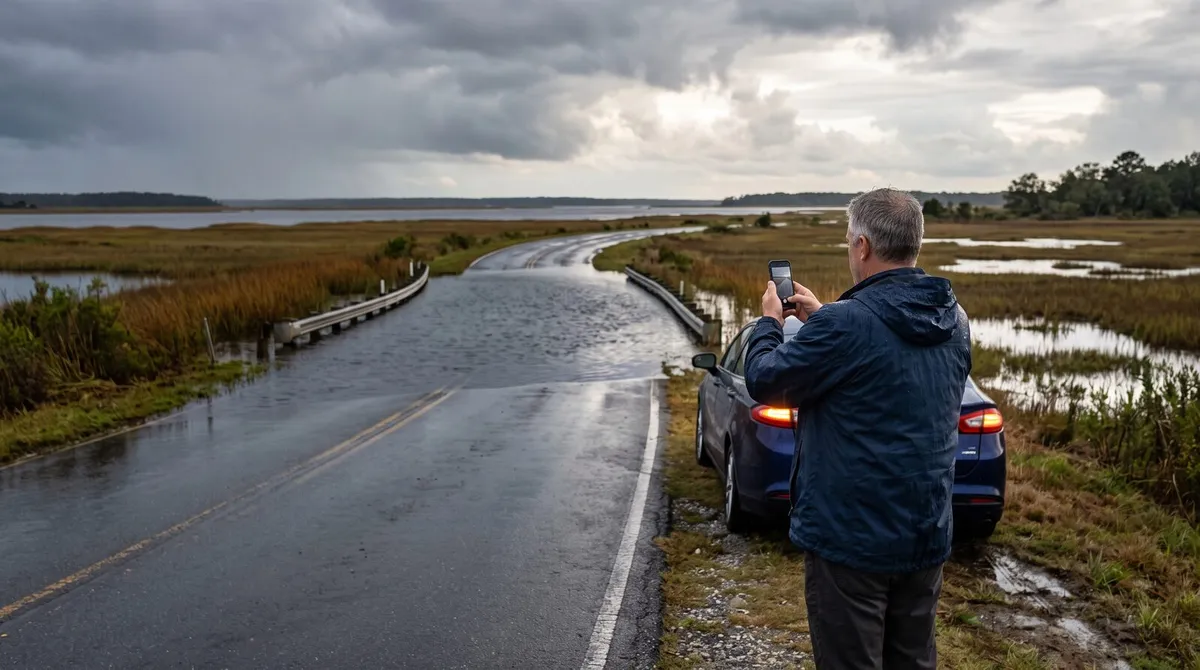
Standing water is evidence that disappears within hours. Once the tide drops or the storm drains catch up, the road looks dry and normal, and the insurer’s version of events becomes easier to believe. The records worth preserving right after a hydroplaning crash include:
- Photos and video of the water on the road, taken from the direction you were driving, plus the waterline on the shoulder and any debris.
- Your own dashcam footage or clips from other drivers and nearby doorbell cameras.
- The time of the crash, so rainfall totals and tide levels for that hour can be pulled from weather and tide records.
- Screenshots of any road-closure or flooding posts from NCDOT, the county, or local police, which are often taken down within days.
- Tire tread and pressure, photographed before the car is repaired or sent to a salvage yard.
- Names and phone numbers of anyone who stopped, and a note of any vehicle that passed through the same water just before you.
When a public agency may be involved, preservation letters and public-records requests go out early, while maintenance records and camera footage still exist.
How long you have to file after a hydroplaning crash
For most injury victims in North Carolina, the filing deadline is three years from the crash under NCGS 1-52(16). A wrongful death claim must be filed within two years of the death. A claim against NCDOT under the Tort Claims Act must also be filed with the Industrial Commission within three years, or within two years if the crash caused a death.
Those deadlines sound long, but the evidence in a flooded-road case does not wait for them. The water is gone the same day, surveillance footage is often overwritten within weeks, and agency records are harder to trace as staff and contractors change. An early review lets me decide whether a road-defect claim is worth pursuing while the proof still exists.
Talking with a Wilmington lawyer about your hydroplaning crash
A hydroplaning crash in eastern North Carolina starts with the assumption that the driver who lost control was going too fast. Hidden water, another driver’s conduct, or a road defect that NCDOT or a city knew about can change that picture, and contributory negligence makes every fact about your own driving matter. Robert L Armstrong handles personal injury cases for injury victims and their families in New Hanover, Brunswick, Pender, Onslow, Bladen, and Duplin counties, and I work each case personally. The consultation is free, and there is no fee unless I win. If you would like to go over what happened on that road, I’d like to hear your story. Talk to a Wilmington car accident lawyer.
Frequently asked questions
Is hydroplaning automatically my fault in North Carolina?
Not automatically, but it is the starting point. A driver who loses control on a wet road is assumed by most insurers to have been going too fast for the conditions. That assumption can be overcome with evidence of hidden standing water, another driver’s conduct, or a road defect. The evidence needs to be gathered while the water, the drainage problem, and the witnesses are still easy to find.
I was a passenger in a car that hydroplaned. Do I have a claim?
Often, yes. A passenger usually has no control over speed or route, so contributory negligence is rarely a barrier for a passenger. The claim typically runs against the liability coverage of the driver who hydroplaned, even when that driver is a family member, and then against any other driver or public agency that contributed to the crash.
What does contributory negligence mean for a flooded-road crash?
Contributory negligence is the North Carolina rule that bars an injured person from recovering anything if their own carelessness contributed to the crash in any amount. On flooded roads, insurers use it when a driver passed a barricade, ignored a road-closed sign, or drove into water that was plainly too deep. There are narrow exceptions, such as the last clear chance doctrine, so the specific facts matter.
I already gave the insurance adjuster a recorded statement. Is my claim ruined?
Usually not. A recorded statement can make the fault argument harder, especially if it includes a guess about your speed or the water depth, but it is only one piece of evidence. I review the statement alongside the crash report, photos, weather data, and any road records before giving a view on the claim.
How long do I have to file a claim after a hydroplaning crash in NC?
Most personal injury claims must be filed within three years of the crash under NCGS 1-52(16), and wrongful death claims within two years. A claim against NCDOT under the Tort Claims Act must be filed with the NC Industrial Commission within three years. City claims can involve separate insurance and immunity questions, so an early review keeps every option open.
What does a consultation about a hydroplaning crash cost?
The consultation is free. If I take the case, I work on a contingency basis, which means there is no fee unless I win. During the consultation I go over the crash report, the photos you have, the road where it happened, and the insurance policies involved, and I tell you plainly whether I think you have a claim.
Standing water evidence is gone within hours of the storm.
Photos of the waterline, tide and rainfall records, and NCDOT complaint logs disappear fast after a flooded-road crash. Get a free review of what happened before the record dries up.
Related Articles
Hurricane-Season Car Accidents in NC: Who's Liable?
Hurricane-season car accidents in NC: how weather affects fault, insurance, and contributory negligence. What eastern NC drivers need to know.

How to Sue City of Wilmington for Road Defect Car Accident
Injured by a road defect in Wilmington? Learn how to sue the City of Wilmington for a road defect car accident. Get expert legal help today.

Car Accident Lawyer Carolina Beach, NC | Guide to Recovery
Injured in a car accident? A Carolina Beach, NC car accident lawyer can help you recover. Protect your rights and get a free consultation today.