Pedestrian accidents at dusk in eastern NC after the clocks change

On this page
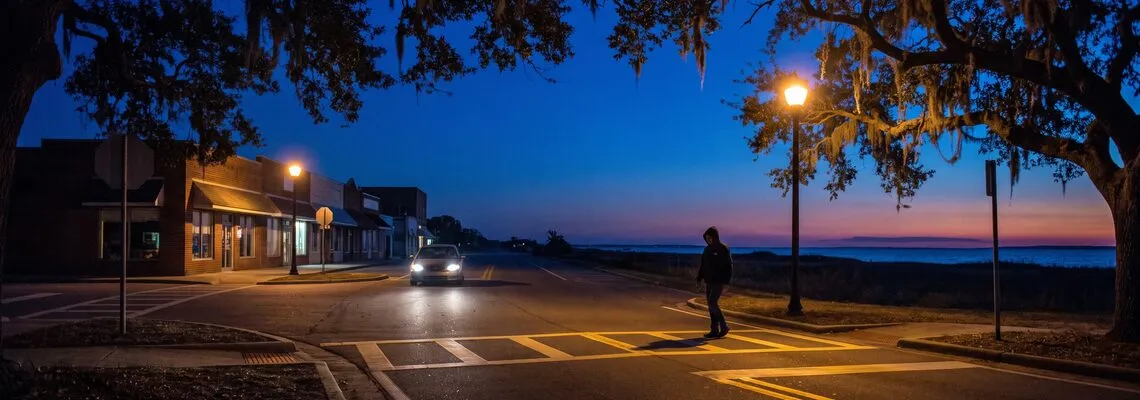
Every fall, my phone rings more often in the first weeks of November with calls about a pedestrian accident at dusk. The calls sound alike: someone walking home from work, to a bus stop, or across a parking lot in the early evening, and a driver who says they never saw the person in front of them. The clock change on the first Sunday in November moves sunset an hour earlier overnight, and the evening rush that was in daylight on Friday is in near darkness on Monday.
I’m Robert L Armstrong, a Wilmington personal injury lawyer with over 41 years of experience, and I represent injury victims and their families across eastern North Carolina. This guide covers why dusk crashes rise after the time change, the North Carolina rules that govern drivers and pedestrians after dark, how the “dark clothing” defense works under North Carolina’s contributory negligence rule, and the steps that protect a claim. It reflects North Carolina law as of October 2026, and it is general information, not advice for your case.
Why pedestrian crashes rise after daylight saving time ends
Daylight saving time ends on Sunday, November 1, 2026. In Wilmington, sunset moves from about 6:20 p.m. on Saturday to about 5:20 p.m. on Sunday, and it keeps creeping earlier until it settles near 5:00 p.m. in early December. Most people’s schedules do not move with it. They leave work, walk the dog, and catch the bus at the same time as the week before, only now in fading light or full dark. That shift is a big part of why pedestrian accidents climb in late fall.
The national numbers show what that means for anyone on foot. In its 2024 pedestrian facts, NHTSA reports that 7,080 pedestrians were killed in traffic crashes, and 76% of those deaths happened in the dark. Daylight accounted for 20%, and dusk and dawn for 2% each. NHTSA’s 2023 data report breaks the numbers down by season: in the fall months, 32% of pedestrian deaths happened between 6:00 and 8:59 p.m., more than any other three-hour window.
North Carolina tracks the national pattern. According to NC Vision Zero, which reports NCDOT crash data, 281 pedestrians were killed on North Carolina roads in 2024, and 66% of fatal pedestrian and bicycle crashes happened where no sidewalk was present. The GHSA report on 2024 data adds that fatal nighttime pedestrian crashes rose 84% between 2010 and 2023, compared with 28% for daytime deaths.

The table below shows how quickly the light changes around the evening rush in Wilmington. Times are rounded to the nearest 5 minutes.
| Date (2026) | Sunset in Wilmington | Full dark (end of twilight) | Light during a 5:30 p.m. walk home |
|---|---|---|---|
| Saturday, October 31 | About 6:20 p.m. | About 6:45 p.m. | Daylight |
| Sunday, November 1 | About 5:20 p.m. | About 5:45 p.m. | Dusk, fading fast |
| Sunday, November 15 | About 5:10 p.m. | About 5:35 p.m. | Near dark |
| Tuesday, December 1 | About 5:00 p.m. | About 5:30 p.m. | Dark |
Dusk is its own hazard. In the half hour after sunset, drivers’ eyes are still adjusting, some drivers have not yet turned on their headlights, and a low western sun can blind anyone driving toward it. People walking assume that because they can see the car, the driver can see them. Often that is not true.
Where dusk pedestrian crashes happen in eastern NC
The highest-risk places in eastern North Carolina share a few features: fast traffic, several lanes, long gaps between signalized crosswalks, and little or no lighting. In Wilmington, that describes stretches of Market Street, Oleander Drive, Carolina Beach Road, and College Road. In Brunswick, Pender, and Onslow counties, it describes the US 17 corridor and the rural two-lane roads where people walk along the shoulder because no sidewalk exists.
| Setting | Why dusk makes it dangerous | What often matters in the claim |
|---|---|---|
| Multi-lane commercial roads | Long walks to the nearest signal, so people cross mid-block in fading light | Driver speed, lookout, and the location of the nearest crosswalk |
| Rural roads without sidewalks | No lighting and narrow shoulders | Whether the pedestrian walked facing traffic, and the driver’s headlight use |
| Bus stops and shopping center entrances | Heavy turning traffic and pedestrians stepping out between cars | Turning-driver yield duties and camera coverage from nearby stores |
| Beach-town streets in the off-season | Fewer streetlights and drivers who expect empty roads | Lighting conditions and whether the driver was distracted |
| Parking lots and driveways | Drivers backing or turning while watching for cars, not people | G.S. 20-173(c) driveway yield rule and private premises lighting |
What North Carolina law says about drivers and pedestrians after dark
Fault in a dusk crash starts with the statutes. Several of them speak directly to visibility, and they apply to both sides of the case.
| Rule | What it requires | Why it matters at dusk |
|---|---|---|
| G.S. 20-129(a) | Headlights from sunset to sunrise, and any time a person on the road cannot be clearly seen 400 feet ahead | A driver without headlights in the dusk window is breaking the law |
| G.S. 20-141(m) | Drivers must slow down as needed to avoid hitting any person on or entering the road, even below the speed limit | “I couldn’t see” is a reason to slow down, not an excuse |
| G.S. 20-173(a) | Drivers yield to pedestrians in marked crosswalks and in unmarked crosswalks at intersections where no signal is operating | The crosswalk right of way does not end when the sun goes down |
| G.S. 20-174(a) and (d) | Pedestrians crossing outside a crosswalk yield to vehicles, and pedestrians walking where there is no sidewalk walk on the left, facing traffic, when practicable | Insurers point to these duties in the fault argument |
| G.S. 20-174(e) | Every driver must use due care to avoid hitting any pedestrian on any roadway | This duty applies even when the pedestrian was outside a crosswalk |
The headlight statute is worth reading in full. G.S. 20-129 requires lighted headlamps “during the period from sunset to sunrise” and whenever there is not enough light to clearly see a person on the highway 400 feet ahead. The second part covers the dusk window directly. A driver who waits until full dark to turn on the lights may already be in violation.
The pedestrian statute cuts both ways. G.S. 20-174 places duties on people crossing outside a crosswalk and walking along roads, but subsection (e) keeps every driver’s duty of due care in place regardless. Most of the pedestrian cases I see at dusk come down to how these two sets of duties fit together on the facts of one evening.
The dark-clothing defense and contributory negligence
North Carolina is one of the few states that still applies contributory negligence in its strict form. If a jury finds the injured person even 1% at fault, the rule can bar recovery entirely. In dusk and nighttime cases, the driver’s insurer almost always looks for that 1%, and the first place it looks is the pedestrian’s clothing.
Does wearing dark clothing at night make a pedestrian at fault?
Not automatically. No North Carolina statute requires a pedestrian to wear reflective or light-colored clothing. Clothing is one fact among many, and a jury weighs it against the driver’s headlights, speed, attention, and how long the pedestrian was in view. A person in a dark jacket who was crossing in a lit intersection, or who had nearly finished crossing a lane, may have been plainly visible to a driver who was paying attention.
| What the insurer argues | What the evidence may show |
|---|---|
| “She was wearing dark clothes.” | The area was lit by streetlights or storefronts, and video shows the pedestrian visible for several seconds |
| “He came out of nowhere.” | Scene measurements show a long, clear sight line, and the driver never braked |
| “She wasn’t in a crosswalk.” | She was in an unmarked crosswalk at an intersection, which carries the same yield duty |
| “The sun was in my eyes.” | Glare required the driver to slow down under G.S. 20-141(m) |
| “He was walking on the wrong side of the road.” | No sidewalk existed and walking facing traffic was not practicable, or the side of the road did not cause the crash |
When the driver had the last clear chance
Even when a pedestrian made a mistake, the last clear chance doctrine can keep a claim alive. It asks whether the driver saw, or with reasonable care should have seen, that the pedestrian was in a helpless or unaware position of danger, and then had the time and means to avoid the crash but failed to use them. A driver with working headlights, a clear view down a straight road, and several seconds to react is the classic last clear chance driver. Proving it usually takes video, scene measurements, and the vehicle’s speed data.
Streetlight outages and road design
Some dusk crashes involve more than the driver. A streetlight that has been out for weeks, a crosswalk with no lighting, or a bus stop placed on a dark stretch with no way to cross can all play a part. Responsibility depends on who owns and maintains the light or the road. In eastern North Carolina, that may be the city, the county, NCDOT, or the power company that maintains many streetlights under contract.
My guide to road defect claims against the City of Wilmington walks through how those claims work. In most dusk cases, the lighting evidence matters even when no public body is a defendant, because it answers the question of how visible the pedestrian was.
Steps to take after a dusk pedestrian crash in eastern NC
Health comes first. After that, the order below tends to protect a dusk claim best, because the evidence that answers “I didn’t see them” is the evidence that disappears fastest.
Call 911 and get medical care the same day
Report the crash so an officer records the scene, the lighting, and the driver's account. Go to the emergency room or urgent care the same day, even if the injuries seem minor. Head and internal injuries do not always show up right away.
Photograph the scene at the same time of day
If you or a family member can, return at the same hour within a few days and photograph the lighting, the crosswalk, the streetlights, and the driver's view of the spot where the crash happened.
Note every streetlight and light source
Write down which streetlights were working, which were out, and whether nearby stores or signs were lit. Take a photo of the pole number on any light that was out.
Collect witness names and camera locations
Get names and phone numbers of anyone who saw the crash. List every store, home, and traffic camera that faces the road. Most systems record over video within days.
Keep the clothes and shoes you wore
Do not wash or throw them away. The actual colors, any reflective trim, and the damage pattern may matter to the fault question.
Be careful with the driver's insurance adjuster
You do not have to give a recorded statement to the other driver's insurer. Questions about what you were wearing and where you were walking are aimed at the contributory negligence defense.
Track your losses and keep every record
Keep a folder of medical bills, missed work, mileage to appointments, and a short weekly note about pain, sleep, and what you can no longer do.

My step-by-step guide for crosswalk accidents covers the general process in more detail. The difference in a dusk case is the focus on light: what the driver could see, when, and why the driver did not react.
Evidence that answers “I didn’t see them”
The driver’s account usually comes down to one sentence. The evidence below is how I test it. Much of it has a short life, so preservation letters go out early in every dusk case I take.
| Evidence | What it can show | How long it usually lasts |
|---|---|---|
| Store, home, and doorbell video | Where the pedestrian was, how long they were visible, and whether the driver braked | Often days to a few weeks before it is recorded over |
| Traffic and city camera footage | Signal timing, vehicle speed, and lighting at the moment of the crash | Varies by agency, and often short |
| Vehicle data and headlight condition | Speed, braking, whether the headlights worked and were on, and windshield condition | Until the car is repaired, sold, or salvaged |
| Driver’s phone records | Calls, texts, or app use in the seconds before the crash | Available through legal process, but must be requested |
| Streetlight outage and repair records | Whether a light was out, for how long, and whether anyone reported it | Depends on the owner’s record-keeping |
| Scene measurements and photos at the same hour | Sight lines and how much light reached the spot | Conditions change with the season, so earlier is better |
Footage is often the single most important piece. My guide to getting traffic camera footage in Wilmington explains how those requests work and why speed matters.
Where compensation comes from after a pedestrian is hit
The first source is usually the driver’s liability insurance. North Carolina’s required minimum limits can be used up quickly by a serious pedestrian injury, which is why I look at every policy that might apply.
A pedestrian’s own auto policy can help even though they were on foot. Uninsured motorist coverage may pay when the driver had no insurance or left the scene, and underinsured motorist coverage may pay when the driver’s limits are too low. These coverages can also come through a policy held by a relative in the same household. GHSA reports that one in four pedestrian deaths involves a hit-and-run driver, and darkness makes it easier for a driver to leave. If that happened to you, my page on hit-and-run claims covers the reporting requirements.
Depending on the facts, an injured pedestrian may be entitled to recover medical expenses, lost income, the cost of future care, and pain and suffering. When a pedestrian dies, the family’s wrongful death claim follows its own rules on who may bring it. Every case is different, and I do not put a number on a claim until I understand the medical picture.
How long do I have to file a pedestrian accident claim in North Carolina?
Most personal injury lawsuits in North Carolina must be filed within three years under G.S. 1-52. A wrongful death lawsuit must be filed within two years of the death under G.S. 1-53. Claims involving a government vehicle or a public road can carry their own notice requirements.
Those are the outer limits. In a dusk case, store and doorbell video is often recorded over within days, so I request it first.
How to stay visible walking at dusk
Prevention is worth a few lines, because the weeks after the clock change are when habits matter most. NCDOT’s Watch for Me NC program focuses on the same basics I hear about in case after case:
- Carry a small flashlight or use your phone’s light, and wear something light-colored or reflective when you can.
- Cross at signals and marked crosswalks, and wait for drivers to stop before stepping out.
- Where there is no sidewalk, walk on the left side of the road, facing traffic.
- Watch for turning drivers and drivers backing out of parking spaces, because both are looking for cars, not people.
- Put the phone away and keep earbuds low near busy roads.
None of this shifts a driver’s legal duties. A pedestrian who did all of it can still be hit by a driver who was speeding, distracted, or driving without headlights.
Talking to a Wilmington pedestrian accident lawyer about a dusk crash
The clock change on November 1 puts thousands of eastern North Carolina commuters on foot in fading light, and the crashes that follow tend to turn on one question: could the driver have seen the person in the road? North Carolina’s headlight, speed, and due-care statutes put real duties on drivers after dark, but the contributory negligence rule means a small fact about clothing or crossing location can become the center of the case. The evidence that answers it, from store video to streetlight records, does not last long.
I represent pedestrians and their families in New Hanover, Brunswick, Pender, Onslow, Bladen, and Duplin counties, and I handle each case personally. The consultation is free, and there’s no fee unless I win. If you or someone in your family was hit while walking at dusk or after dark, I’d like to hear your story. Talk to a Wilmington pedestrian accident lawyer about what happened and what your options are.
Frequently asked questions
Is a pedestrian automatically at fault for walking at night in dark clothing?
No. North Carolina has no law that requires a pedestrian to wear reflective or light-colored clothing. Dark clothing is something an insurer may raise under the contributory negligence rule, but the driver still has to use headlights, keep a proper lookout, slow down to avoid a person in the road, and use due care under G.S. 20-174(e). Whether clothing matters depends on the lighting, the driver’s speed, and how long the pedestrian was visible.
Can I bring a claim if a streetlight was out where I was hit?
Possibly, though these claims are harder than claims against the driver. The question is who owned and maintained the light, whether they knew it was out, and how long it stayed broken. Claims against a city, county, or state agency follow special rules on immunity and notice, so I look at the lighting question early, while outage reports and repair records can still be requested.
What if the driver says the sun or the dark made it impossible to see me?
Glare and darkness do not excuse a driver. G.S. 20-129 requires headlights from sunset to sunrise and whenever a person cannot be clearly seen 400 feet ahead, and G.S. 20-141(m) requires drivers to reduce speed as needed to avoid hitting a person. A driver who could not see should have slowed down. Video, scene measurements, and the vehicle’s headlight condition often answer this argument.
How long do I have to file a pedestrian accident claim in North Carolina?
Most personal injury lawsuits must be filed within three years under G.S. 1-52, and wrongful death lawsuits within two years of the death under G.S. 1-53. Claims involving a government vehicle or a public road condition can raise extra notice issues. Camera footage and witness memories disappear much sooner, so it helps to start early.
The driver who hit me left the scene. Do I have any options?
Yes. Report the crash to the police right away. If the driver is never found, uninsured motorist coverage on your own auto policy, or on a policy held by a relative in your household, may still be available even though you were on foot. These claims usually require prompt reporting to law enforcement.
What does it cost to talk with you about a pedestrian accident?
The consultation is free, and there’s no fee unless I win your case. I’ll listen to what happened, look at the crash report, photos, and any video, and tell you plainly what I see as the strong points and the weak points of the claim.
Hit while walking after dark? The evidence fades fast.
Headlight condition, streetlight records, and camera footage decide most dusk pedestrian cases, and much of it is gone within days. Get a free review while it can still be collected.
Related Articles

How to Sue City of Wilmington for Road Defect Car Accident
Injured by a road defect in Wilmington? Learn how to sue the City of Wilmington for a road defect car accident. Get experienced legal help today.

Get Traffic Camera Footage for Car Accident | Wilmington, NC
Need traffic camera footage after a car accident in Wilmington, NC? Learn the steps to secure video evidence fast. Call for experienced legal help today.
Pedestrian contributory negligence in NC and cyclist claims
Crossing outside a crosswalk is not automatic fault in NC. The G.S. 20-174 duties, child age rules, and cyclist cases for Wilmington. Free consultation.