Attractive nuisance in NC: pools, trampolines and children

On this page
Attractive nuisance is the phrase most people use for a simple idea: a property owner can be responsible when a child is hurt by something dangerous the child could not be expected to understand. The words never appear in a North Carolina statute, though. The General Assembly wrote the idea into the law in 2011 and replaced the loose common-law label with a five-part test that applies the same way to a swimming pool, a trampoline, a construction site, or an abandoned building.
I’m Robert L Armstrong, a Wilmington personal injury lawyer with over 41 years of experience, and I represent injury victims and their families in eastern North Carolina. This guide explains the five elements, who counts as a child trespasser, how the test plays out for each common hazard, what the pool barrier code adds, and how a coastal market full of vacation rentals and community pools changes the analysis. It reflects North Carolina law as of October 2026.
What is an attractive nuisance in North Carolina?
An attractive nuisance is a dangerous man-made condition on someone’s land that draws children onto the property and injures them. North Carolina sorts people on land into two groups, as I explain in my guide to lawful visitor status. A lawful visitor has the owner’s permission and is owed reasonable care. A trespasser does not have permission, and the starting rule is harsh. Under G.S. 38B-2, a possessor of land, meaning an owner, lessee, or other occupant, owes a trespasser no duty of care and is not liable for the trespasser’s injury.
Chapter 38B is titled the Trespasser Responsibility Act, and it lists three exceptions to that harsh rule. One covers intentional or willful harm. One covers a trespasser the owner discovers in a position of peril. The third covers children hurt by an artificial condition on the land, and that third exception is the attractive nuisance rule in practice. It applies to claims for injury and to claims for death.
What are the five parts of North Carolina’s attractive nuisance test?
Under G.S. 38B-3, subsection (2), an owner may be liable for a child trespasser’s injury or death from an artificial condition only if all five of these are true:
- Children were likely to trespass there. The owner knew or had reason to know that children would be likely to enter at the location of the condition.
- The risk was serious. The owner knew or reasonably should have known the condition involved an unreasonable risk of serious bodily injury or death to children.
- The child did not see the danger. The injured child did not discover the condition or did not realize the risk, including the risk of coming into the area the condition made dangerous.
- Protection was cheap. The usefulness of the condition to the owner and the burden of eliminating the danger were slight compared with the risk to the child.
- The owner did not act. The owner failed to use reasonable care to eliminate the danger or otherwise protect the child.
This structure follows the familiar approach in section 339 of the Restatement (Second) of Torts, which many states use. The UNC School of Government’s pattern jury instruction, N.C.P.I.-Civil 805.64B, shows what a jury is actually asked. It lists nine things the injured child must prove, because the five statutory elements sit alongside four more: the person being sued was a possessor of the land, the injured person was a child trespasser, the hazard was an artificial condition, and the owner’s conduct caused the injury or death. The instruction applies to claims arising on or after October 1, 2011.

Proof usually comes from the property itself. Worn paths, a gap in a fence, a gate that no longer latches, earlier complaints from neighbors, and prior incidents all speak to whether the owner knew children came around. The fourth element rests on cost. A fence, a latch, a cover, or a locked gate is inexpensive compared with a drowning, so owners with a known hazard and no barrier have a hard time on that point.
Who counts as a child trespasser in North Carolina?
The statute answers the age question directly. Under G.S. 38B-4, a child trespasser is a trespasser who is less than 14 years old or who has the level of mental development of a person less than 14. A trespasser is anyone who enters another person’s property without permission and without an express or implied invitation.
Two consequences follow. A 15-year-old who climbs a fence to swim at night is an ordinary trespasser, so the owner owes no duty except in the narrow situations in G.S. 38B-3. An older teenager or adult with a significant cognitive disability may still qualify under the mental development language, which is a fact question I look at closely when a family describes one.
Is a swimming pool an attractive nuisance in NC?
A pool can qualify, though the statute does not name pools and no pool is covered automatically. The element that decides most pool cases is the third one, whether the child realized the risk. An owner will argue that every child knows water is dangerous. A family can respond that a toddler does not, that a nine-year-old may not grasp a drop-off, a cover that will not hold weight, or a pool that looks shallow at night, and that a child’s understanding depends on age, experience, and the specific condition.
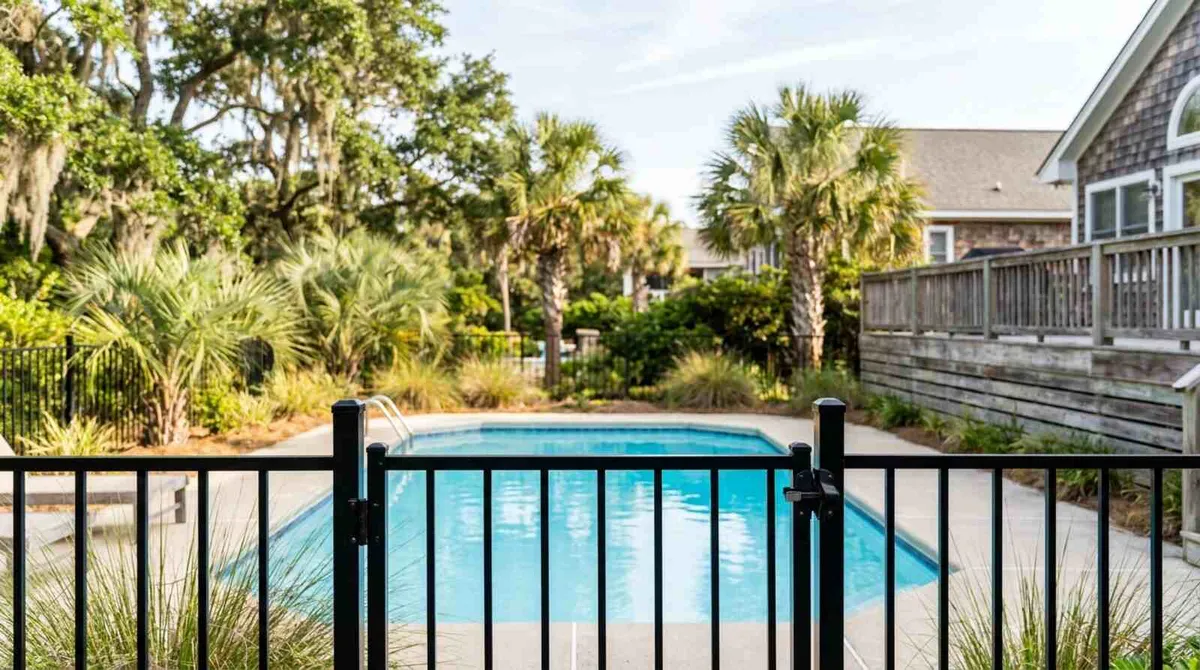
Drowning is a leading threat to young children. The CDC reports that drowning is the leading cause of death for children ages 1 to 4, and that a four-sided isolation fence separating the pool from the house and yard reduces a child’s drowning risk by 83% compared with a fence around only the property line. The U.S. Consumer Product Safety Commission’s Pool Safely campaign recommends a fence at least four feet high on all sides with a self-closing, self-latching gate.
North Carolina’s residential code points the same direction. The swimming pool appendix of the North Carolina Residential Code requires a barrier at least 48 inches high, openings too small for a 4-inch sphere to pass, and pedestrian gates that open outward away from the pool and are self-closing and self-latching. The code sets the height of the latch release too, which is a detail that matters when a small child can reach a handle. A missing barrier or a gate that does not latch does not create a claim on its own. It is strong evidence on the fourth and fifth elements, because it shows what protection cost and that the owner skipped it. I also pull permit and inspection records, since a pool built years ago may have been approved under earlier rules.
Is a trampoline an attractive nuisance in NC?
A trampoline is plainly an artificial condition, so the fights happen on the other elements. Owners and insurers argue that the risk of a fall is obvious to a ten-year-old, which goes to the third element, and that the owner had no reason to expect neighborhood children to climb in, which goes to the first. A family answers with facts: a trampoline visible from the street, no enclosure netting, no fence, and earlier use by neighborhood children that the owner saw and never stopped.
The invitation question matters here too. If the owner let the neighbor’s child bounce, that child is a lawful visitor and the claim is an ordinary negligence claim with no five-part test. The child trespasser rule matters when the child came over uninvited, which is why I ask early who said what on the day it happened.
Construction sites, abandoned property and other hazards
The test is the same for every artificial condition, and the hazards I see most often fall into a few groups:
- Construction sites. Open trenches, excavations, stacked materials, scaffolding, and unlocked equipment or vehicles. The responsible party may be an owner, a contractor in control of the site, or a property manager, because G.S. 38B-4(2) defines a possessor to include a lessee, an occupant, or a person acting on behalf of a lawful possessor.
- Abandoned property. Vacant houses, partially built structures, old wells and cisterns, and neglected pools. The question is who holds lawful possession and control, which can be an owner, a lender after foreclosure, or a management company.
- Other man-made hazards. Retention ponds, docks, bulkheads, equipment left running, and attractive piles of debris.
A natural condition is not an artificial one, so a tidal creek or marsh is treated differently from a man-made pond or a dock. The statute does not define the term. The pattern instruction notes that earlier North Carolina case law described artificial conditions as those not “natural and obvious” and that the committee takes no position on whether that definition carries over, so I treat the point as open and build the facts around it.
What changes when the child was invited?
An invited child is a lawful visitor, not a trespasser. In Nelson v. Freeland in 1998, the North Carolina Supreme Court held that owners and occupiers owe lawful visitors one duty of reasonable care. That means a neighbor’s child at a birthday party, a guest’s child at a rental, or a customer’s child in a store gets the ordinary negligence standard. The five-part test never comes into play, and the case turns on what the owner knew about the hazard and what the owner did about it.
Status can still become a contested issue. A child who walks through a gate that was clearly closed off, or into a pool area the owner told guests to stay out of, may be treated as a trespasser for that area. Insurers raise that argument often, and I look at the signs, the latches, and the supervision before accepting it.
How do vacation rentals and community pools change a Wilmington claim?
The coastal market adds fact patterns inland counties see less often. A vacation rental with a pool sits empty between guests, and neighborhood children know it. Families rent houses and bring children who treat a back deck and a pool as one play space. Condominium and neighborhood pools are open all summer to dozens of children at once. I cover the guest side of these cases in my posts on vacation rental injuries and Airbnb claims. When a child or an adult drowns or nearly drowns at one of these pools, my swimming pool accident page explains how I work those cases.
Which rulebook applies depends on the pool. Under G.S. 130A-280, a private pool serving a single-family home and used only by the residents and their guests falls outside the state’s public pool rules, even when guests reach it through a sharing platform or pay a fee. The statute still requires that pool to be maintained in good and safe working order. Hotel, motel, apartment, and membership-facility pools are public swimming pools, and the state’s pool fence rule requires a barrier at least 48 inches high and pedestrian gates that open outward, close on their own, and latch.
A fence knocked down in a storm and left unrepaired raises the same questions as a fence never built. Either way, I want to know who had the duty to fix it, what that person knew, and how long the gap stayed open.
Can the insurer blame the child for what happened?
The insurer can try, but North Carolina protects young children from that argument. A child under 7 is conclusively presumed incapable of contributory negligence. For a child from 7 to 14, the law presumes the child is incapable, and the defense can overcome that presumption only with evidence that a child of that age ordinarily would have the judgment and capacity to understand and avoid the danger. The UNC School of Government’s pattern instruction sets out those presumptions.
The stakes are high because contributory negligence can bar an entire claim in North Carolina, and I explain how insurers press the same argument against adults in my post on the 1% rule. A child who has turned 14 is presumed capable of understanding danger, so the rule matters more as children get older.
The insurance picture matters for families as well. Most homeowner’s policies carry personal liability coverage, and a claim after a pool or trampoline injury usually runs through it. Limits vary, and some insurers condition coverage on a fenced and locked pool. If a death occurred, the claim belongs to the estate, and I explain how that works on my wrongful death page.
Deadlines depend on who owns the claim. G.S. 1-17 generally lets a minor bring the child’s own claim after reaching 18, but claims that belong to the parents, such as medical bills, and wrongful death claims can run on shorter clocks. Surveillance video, fence repairs, and neighbors’ memories change long before any deadline, which is why I ask families to call early.
Talking to a Wilmington premises liability lawyer about a child’s injury
Families who call me after a child is hurt on someone’s property often have the owner’s insurer calling them too. I explain which rule applies, what the five elements require, and what evidence to protect, for injury victims and their families in New Hanover, Brunswick, Pender, Onslow, Bladen, and Duplin counties. The consultation is free, and there is no fee unless I win. Talk to a Wilmington premises liability lawyer about what happened, and I will tell you honestly how the law looks for your child.
Frequently asked questions
Is a swimming pool an attractive nuisance in North Carolina?
It can be, but no pool qualifies automatically. G.S. 38B-3(2) never names pools. A child under 14 must have trespassed, the owner must have known children were likely to come, and the cost of a fence or locked gate must have been slight compared with the risk of drowning. The hardest element is usually whether the child understood the danger, which depends heavily on the child’s age.
At what age does the attractive nuisance rule stop applying in NC?
At 14. G.S. 38B-4(1) defines a child trespasser as a trespasser under 14 years old, or one with the mental development of a person under 14. A 15-year-old who climbs a fence to swim at night is an ordinary trespasser, and the owner owes that trespasser no duty of care except in the narrow situations listed in G.S. 38B-3.
Will the homeowner’s insurance pay if a neighbor’s child is hurt on a pool or trampoline?
Often the homeowner’s personal liability coverage responds, but limits and conditions vary by policy. Some insurers require a fence and a locked gate around a pool, and some exclude or restrict trampolines. I look at the actual policy, the limits, and whether an umbrella policy exists before anyone decides how a claim is likely to resolve.
Can the insurer say my child caused the injury?
It can try. North Carolina treats a child under 7 as conclusively incapable of contributory negligence. For a child from 7 to 14, the law presumes the child is incapable, but the defense may try to overcome that with evidence about the child’s age, judgment, and experience. A child who has turned 14 is presumed capable, so contributory negligence becomes a much larger concern.
My child was invited to a pool party and was hurt. Is that an attractive nuisance case?
Usually not. A child invited by the owner is a lawful visitor, and under Nelson v. Freeland the owner owes lawful visitors reasonable care. The five-part child trespasser test applies only when the child was a trespasser. If the child wandered into an area the owner clearly closed off, the status question can become part of the case.
How long do I have to file a claim after a child is hurt or killed on someone’s property?
Most personal injury claims must be filed within three years under G.S. 1-52, but G.S. 1-17 generally lets a minor file the child’s own claim after turning 18. Claims that belong to the parents, such as the child’s medical bills, can follow a different clock. A wrongful death claim generally must be filed within two years of the death. Evidence disappears long before any of those dates.
What does it cost to talk with you about a child’s injury on someone’s property?
The consultation is free, and there is no fee unless I win. I listen to what happened, who owned or controlled the property, and what was or was not in place to keep children out, then I tell you plainly whether I think North Carolina law helps your family.
Was a child hurt where a hazard was left open?
Photos of a fence, a gate latch, or a hazard in the yard disappear fast after an injury. Get a free review of how North Carolina's child trespasser rule applies to what happened.
Related Articles

Contributory negligence in NC slip and fall claims
NC's 1% contributory negligence rule can bar a Wilmington slip and fall claim over footwear, phone use, or an obvious hazard. Schedule a free consultation.
Why NC calls a business invitee a lawful visitor
North Carolina merged business invitee and licensee into lawful visitor in 1998. Trespasser status cuts your protection. Free Wilmington-area consultation.

Vacation Rental Injury Lawyer Wilmington NC | Legal Rights
Injured at a Wilmington vacation rental? Our vacation rental injury lawyer will protect your rights and fight for compensation. Free consultation.