NC motorcycle insurance after the 2025 limit hike

On this page
A motorcycle claim exposes thin coverage faster than almost any other kind of wreck I handle. Riders get hurt worse per crash than drivers in cars, and North Carolina’s minimum insurance limits, even the higher ones that took effect in 2025, can still fall short of a single hospital stay.
I’m Robert L Armstrong, and I have represented injured riders in eastern North Carolina for over 41 years. State law requires every motorcycle to carry liability insurance before it touches a public road. What that insurance has to include changed on July 1, 2025, so riders shopping for a policy or renewing one need to know both the new minimums and which optional coverages actually matter after a crash.
How much motorcycle insurance do I need in NC?
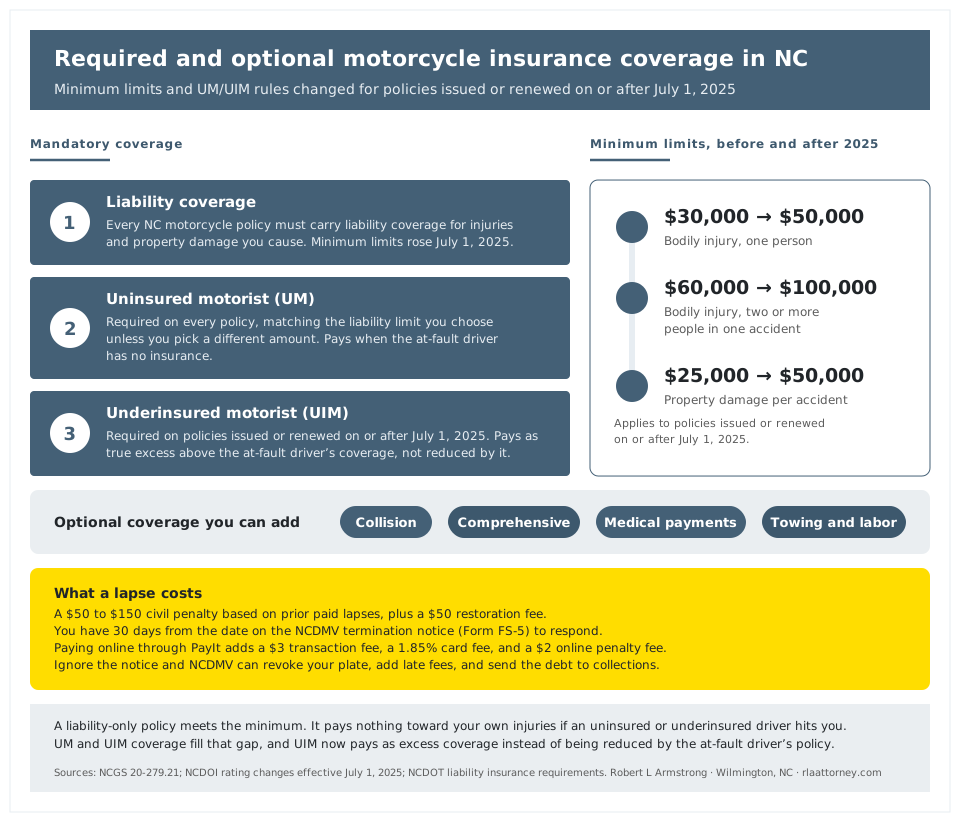
The legal floor and the amount I’d actually recommend are two different numbers. North Carolina requires liability coverage of at least $50,000 per person and $100,000 per accident for bodily injury, plus $50,000 for property damage, on any motorcycle policy issued or renewed on or after July 1, 2025. The policy must also carry uninsured motorist coverage, and I encourage riders to set those limits at what they would actually want paid out if someone hit them, not just the state floor.
A minimum-limit policy satisfies the law but rarely covers a serious injury. In the motorcycle cases I handle, emergency care, surgery, and rehab for a single rider can use up a $50,000 per-person limit quickly, which is why I treat the state minimum as a starting point, not a target. Those figures come from the NC Department of Insurance, and they apply to every motorcycle and scooter registered in the state.
Does North Carolina require motorcycle insurance?
Yes, without exception. Under G.S. 20-279.21, a motorcycle is a motor vehicle for insurance purposes, and the owner must carry a liability policy that meets the state’s minimum limits before the bike is registered. The rider also needs a motorcycle endorsement on their driver’s license, a separate requirement from the motorcycle laws covering how you ride, and a valid insurance card has to stay with the bike or on the operator at all times. Riding without it is both a traffic violation and, if you crash, a coverage problem for you and anyone you hurt.
What changed in NC’s motorcycle insurance minimums on July 1, 2025?
For decades, North Carolina’s minimum liability limits sat at $30,000 per person, $60,000 per accident, and $25,000 for property damage. Under Session Law 2023-133 (originally Senate Bill 452), as later amended, those limits rose to $50,000, $100,000, and $50,000 for every policy issued or renewed on or after July 1, 2025. Any policy issued or renewed since that date carries the higher limits. If you’re reviewing an older declarations page, for example from a crash that happened before July 1, 2025, the old $30,000/$60,000/$25,000 limits may still be the ones that apply.
The same legislation folded underinsured motorist coverage into every new and renewed policy. Before July 1, 2025, a policy written at the old minimum limits didn’t include UIM coverage at all, because the formula that decides whether a driver counts as “underinsured” compared their liability limits to your own, and a minimum policy can’t be underinsured relative to itself. That gap is gone now. UIM coverage comes standard on new and renewed policies regardless of the limits chosen.
Why the 2025 UIM change matters for injured riders
For riders, the bigger change is how UIM now pays. Under the old rule, your UIM payout got reduced, dollar for dollar, by whatever the at-fault driver’s liability insurer already paid you. A rider with $100,000 in UIM coverage who collected $30,000 from a minimally insured driver only had $70,000 of UIM left to draw on.
As of July 1, 2025, that setoff is gone. UIM coverage now applies on top of whatever the at-fault driver’s policy pays, as true excess coverage, and it’s calculated against your total damages rather than against the other driver’s policy limits. That same rider with $100,000 in UIM now has the full $100,000 available after the at-fault driver’s $30,000 is exhausted, not $70,000. For a motorcycle claim, where injuries are often severe and the at-fault driver frequently carries only the minimum, that change can be the difference between a recovery that covers your medical bills and one that doesn’t.
What optional motorcycle coverage should I consider?
Beyond the mandatory liability, UM, and UIM coverage, most insurers offer several optional add-ons for motorcycle policies:
- Collision pays to repair or replace your motorcycle after a crash, regardless of fault, up to its actual cash value.
- Comprehensive (sometimes called “other than collision”) covers damage from theft, fire, hail, or hitting an animal, situations that have nothing to do with a collision.
- Medical payments coverage pays reasonable medical and funeral expenses after a crash, regardless of fault, up to the limit you choose. NCDOI lists this as an available option for NC motorcycle policies, so if your current policy doesn’t carry it, it’s worth asking your agent to add it.
- Towing and labor covers roadside assistance if your bike breaks down.
Of all of these, I’d still put UM and UIM ahead of the rest for a rider. Collision and comprehensive protect the bike. UM and UIM protect you, and on a motorcycle, the injuries are usually the expensive part.
A few other details are worth checking before you assume a policy is complete. Custom paint, aftermarket exhausts, and upgraded suspension usually aren’t covered under a standard collision or comprehensive limit unless you’ve added custom-parts coverage and told your insurer what the bike is actually worth. If you ride with a passenger regularly, confirm that your liability and medical payments limits are written to cover a second person, not just the operator. And if your policy lists specific named riders instead of any rider with permission, letting a friend take the bike for an afternoon can create a coverage gap nobody notices until there’s already been a crash.
Does my car insurance cover my motorcycle?
No. A motorcycle needs its own liability policy, separate from any car, truck, or SUV policy you carry. Auto insurers underwrite motorcycles differently because the risk profile is different, and a standard car policy typically excludes motorcycles outright. If you own both a car and a bike, expect two separate policies, possibly with the same carrier, but with different limits, different premiums, and coverage that has to be confirmed on the motorcycle policy specifically.
Some riders assume an umbrella policy sitting on top of their homeowner’s and auto coverage automatically extends to the motorcycle. That depends entirely on how the umbrella policy defines a covered vehicle, and many exclude motorcycles unless the underlying motorcycle policy is specifically scheduled underneath it. Before a trip, not after a crash, is the right time to ask your agent whether your umbrella coverage actually reaches the bike.
What happens if my motorcycle insurance lapses in NC?
NCDMV tracks coverage electronically. When an insurer reports a cancellation or lapse, NCDMV sends a termination notice, identified as Form FS-5, to the registered owner. You have 30 days from the date printed on the notice to respond (the window was 10 days before October 1, 2026), and failing to respond can lead to a revoked plate, late fees, and collections. If the coverage genuinely lapsed, the next steps are:
- You’ll owe a civil penalty: $50 for a first lapse, $100 for a second, or $150 for a third or later lapse, based on how many prior paid lapses you’ve had on that vehicle within three years.
- A $50 restoration fee applies at your next registration renewal.
- Until the penalty and fee are paid, your plate can be revoked, and driving on a revoked plate creates its own problems.
- If you pay online through NCDMV’s PayIt portal, expect a $3 transaction fee, a 1.85 percent card processing fee, and a $2 online civil penalty fee on top of the penalty itself.
If the notice is a mistake, your insurer can submit a Certificate of Insurance (Form FS-1) electronically to show your coverage never actually lapsed, which clears the penalties once NCDMV processes it. Riders who believe a revocation happened through no fault of their own can also request an administrative hearing rather than simply paying the fine.
Who pays my medical bills after a motorcycle crash in NC?
North Carolina is an at-fault state, so the at-fault driver’s liability insurer is responsible for your injuries, but that insurer does not pay bills as they come in. It usually pays once, at the end of the claim. In the meantime, your own health insurance and any medical payments coverage on your motorcycle policy are what keep bills from going to collections. Medical payments coverage pays regardless of fault, up to the limit you chose, which is one more reason to ask whether your policy carries it.
If the driver who hit you had no insurance, or left the scene, your uninsured motorist coverage steps into the at-fault driver’s place. If the driver had some insurance but not enough, your underinsured motorist coverage picks up where their policy stops. Health insurers and medical providers who are paid along the way may have a right to be repaid from the recovery, so the order in which each policy pays matters when the claim is resolved.
Getting help with a motorcycle insurance question or claim
The insurance side of a motorcycle crash rarely gets easier once you’re the one who’s hurt. An adjuster who sounds friendly on the phone still has to follow the policy language, and whether your claim draws on $50,000 in minimum liability or a UIM policy that now pays as true excess can change the outcome by a wide margin. I handle motorcycle liability disputes in New Hanover, Brunswick, Pender, Onslow, Bladen, and Duplin counties and throughout eastern North Carolina, and I read the policy language closely so injury victims and their families don’t have to guess at what coverage applies. Talk to a Wilmington motorcycle accident lawyer about your coverage, your options, and what a fair recovery would actually look like.
Frequently asked questions
What is the minimum motorcycle insurance required in NC?
For policies issued or renewed on or after July 1, 2025, North Carolina requires liability coverage of at least $50,000 per person and $100,000 per accident for bodily injury, plus $50,000 for property damage. Uninsured and underinsured motorist coverage are required too, matching your liability limit unless you choose different amounts.
Do I need a motorcycle endorsement as well as insurance to ride in NC?
Yes. Every motorcycle registered in North Carolina must carry a liability policy that meets the minimums in NCGS 20-279.21, and the rider also needs a motorcycle endorsement on their driver’s license.
Does my motorcycle policy cover a passenger?
Usually, through your liability coverage. If your passenger is hurt in a crash you caused, their claim runs against your liability limits the same as any other injured person’s, so a $50,000 per-person limit is the most your policy pays them. If another driver caused the crash, your passenger can claim against that driver’s insurance, and UM or UIM coverage may apply if that driver had none or not enough. Medical payments coverage, if you carry it, often extends to passengers too, but confirm the wording on your policy.
Will my umbrella policy cover my motorcycle?
Only if the umbrella policy says so. Many umbrella policies exclude motorcycles outright, and others cover a bike only when the motorcycle policy is listed as underlying coverage at limits the umbrella insurer sets, often well above the state minimum. If the motorcycle isn’t scheduled under the umbrella, the umbrella won’t respond to a crash on the bike, so ask your agent to confirm it in writing.
Is medical payments coverage available on a motorcycle policy in NC?
Yes. NCDOI lists medical payments coverage as an available option on NC motorcycle policies, alongside collision and comprehensive coverage. It’s optional, not mandatory, so check your declarations page to see whether you carry it.
How long do I have to respond to an NCDMV insurance lapse notice?
You have 30 days from the date printed on the termination notice (Form FS-5) to respond. The window was 10 days before October 1, 2026. If the lapse is real, you’ll owe a civil penalty of $50, $100, or $150 based on how many prior paid lapses you’ve had on that vehicle within three years, plus a $50 restoration fee. Failing to respond can lead to a revoked plate, late fees, and collections.
Is UIM coverage worth carrying on a motorcycle in NC?
I think so. Since July 1, 2025, UIM pays as true excess over the at-fault driver’s liability coverage rather than being reduced by it, which matters a lot on a motorcycle, where injuries routinely outrun a minimum liability policy. My UIM claims guide walks through how a claim like that actually gets paid.
How much does it cost to talk to you about my coverage or a claim?
The consultation is free, and there’s no fee unless I win your case. I’ll look at your declarations page, explain what you’re carrying, and tell you honestly whether I think a claim is worth pursuing.
Minimum coverage rarely covers a serious motorcycle crash.
North Carolina's new limits are higher than they used to be, but a bad wreck can still outrun them fast, and UIM coverage is often the only protection against an underinsured driver. Get a free review of your policy and your claim.
Related Articles

Motorcycle Road Rash Injury? Wilmington Lawyer Can Help
Injured in a Wilmington motorcycle accident? Get help from a motorcycle road rash injury lawyer. Protect your rights and claim. Free consultation today.
Motorcycle Laws in North Carolina
North Carolina motorcycle laws explained: the helmet requirements, licensing, lane rules, and how a single violation can affect your accident claim.

How Is Liability Determined in A Motorcycle Accident
Motorcycle accident cases are typically more complicated than other vehicle accident cases, due to the severity of injuries and unique factors involved.